

Skip to Content

CDR is Expanding to Include Non-bank Lenders. What Does it All Mean?

cdr-is-expanding-to-include-non-bank-lenders-what-does-it-all-mean

This year, Australia’s Consumer Data Right (CDR) is expanding to include the non-bank lending sector. Specific Non-bank Lenders will be designated as ‘Data Holders’ within the CDR framework, requiring them to implement systems to facilitate consumers in being able to transfer their data to accredited third parties.    

This builds upon the designations in the Banking and Energy sectors, where Data Holders are already operational, allowing consumers to effectively transfer their data. 

November 2024 marks the first milestone for Non-bank Lenders. So what do Non-Bank Lenders need to be aware of? 

Quick recap

The Consumer Data Right (CDR) is an economy wide designed to empower consumers with greater control over their data. It facilitates the secure sharing of data, currently housed in various organisations, with third parties in taking up new services. Banking was the first implementation of the CDR, commonly known as Open Banking, allowing consumers to consent to sharing their banking data with accredited third parties. For more detailed information on Open Banking, refer to Basiq’s definitive guide.

Following Banking, the Energy sector adopted the CDR and soon, Non-bank Lenders will join this initiative. Presently there are over 90 Banks and Energy providers acting as data holders. To see the complete list

Which Non-Bank Lenders must serve as Data Holders?

Treasury has delineated two categories of providers:

Initial provider: A non-bank lender that on the commencement date has over $10 billion in loans/leases and has averaged over $10 billion for the preceding 11 months.

Large provider: A non-bank lender that on the commencement date has over $500 million but less than $10 billion in loans/leases, averaged over $500 million for the preceding 11 months, has more than 500 customers.

What types of Non-Bank Lenders does it apply to?

Some examples of organisations it applies to include:

  • Mortgage lenders
  • Consumer finance companies
  • Buy Now Pay Later (BNPL) providers
  • Leasing and hire purchase providers
  • Marketplace lenders
  • Payday lender
  • Peer-to-peer lenders
  • Salary advance providers

What are Data Holders required to do?

Data Holders must be authorised by the ACCC, fulfilling specific criteria for data security, privacy, and technical capabilities. The implementation of robust security measures, such as encryption and access controls is required to safeguard data. Privacy compliance is crucial, ensuring data use aligns with relevant privacy laws.

Data Holders are obligated to adopt technical standards to facilitate seamless data sharing across  entities within the CDR ecosystem. This involves establishing a consent management framework to obtain and manage consent from consumers. 

Furthermore, ongoing regulatory oversight requires Data Holders to submit regular compliance reports to the ACCC and promptly address any inquiries and issues that may arise.

What are the key dates?
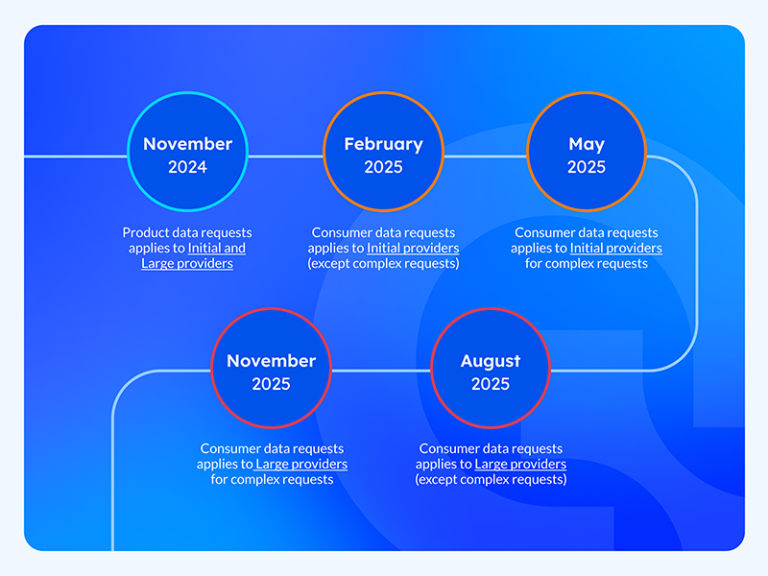
What is a complex request?
A “complex request” under the draft rules is a consumer data request that:

  • Is made on behalf of a secondary user of the consumer
  • Relates to a joint account or a partnership account
  • Is made on behalf of a non-individual CDR consumer whose authorisations are handled by a nominated representative

I’ll be required to be a Data Holder, what should I do?

While providing access to consumer and product data via APIs seem straightforward, the process of becoming a Data Holder is a complex undertaking. Beyond initial requirements, there are continuous obligations related to regulatory changes, maintenance and reporting. Based on feedback from existing Data Holders in the banking sector, it’s prudent to consider engaging a Partner with the requisite  expertise, experience and knowledge.  

Given the urgency and complex requirements, Non-bank Lenders falling under the scope of becoming a Data Holder should take proactive steps in initiating their CDR implementation projects. Here are our recommended actions. 

Step 1: Requirements and Timing
Familiarise yourself with what’s required and “go-live” deadlines

Step 2: Engage a Partner
Work with a Partner that can help you navigate the complex build and maintenance requirements

Step 3: API development
Start building the internal API layer to surface Users, Accounts, Transactions – needs to be done regardless of whether you engage a Partner or not. 

The Start of a New Era in Lending: How Open Banking is Changing the Game

how-open-banking-is-changing-the-game-for-lenders

As a lender, you want to do everything you can to fast-track approval times, boost conversion rates and deliver a seamless customer experience. 

But if you’re relying on web connectors (often referred to as ‘screen scraping’) alone to access customers’ financial data, you’re leaving your business vulnerable to disruptions that could encourage customers to abandon their loan application and take their business elsewhere.

Increasingly, Open Banking is becoming the preferred option for innovative lenders looking to stand out in a competitive market. In fact, lending is one of the most popular use cases for Open Banking.

With improved speed, connectivity, security and greater customer control, Open Banking benefits both the lender and their customers by enabling faster, more informed lending decisions that will help boost conversation rates.

The risks of accessing financial data via screen scraping 

Imagine losing the ability to connect to customer financial data that sits with the major banks for a lending assessment. Whether you’ve encountered issues with transaction data to date or not, the consensus is clear: screen scraping to access banking data is on its way out.

Screen scraping is a degrading data access method, leaving lenders vulnerable to increased customer churn and negative brand perceptions, ultimately impacting the ability to attract new customers and their bottom line. 

If access to financial data via screen scraping goes down during the application process, you lose access to the information needed to quickly and efficiently make a lending decision, leaving you unable to service that customer at that time. 

Consumers have hundreds of options at their fingertips and are likely to look elsewhere if they encounter errors, issues or roadblocks such as failed screen scraping in the application process. Plus, screen scraping’s reliance on a customer remembering their online banking details can prove a major drop-off point, too. 

Here’s what we know:

  • Online fraud is on the rise: Australian customers and businesses lost an estimated $4 billion to scams in 2022 (nearly double the losses reported in 2021). In the wake of major data breaches, banks are levelling up their security measures through steps such as multi-factor authentication.

    The consequence? When it comes to web connectors, we are seeing a reduction in the speed data is returned, a decline in the reliability of some connectors and, in worst case scenarios, access to customer banking data is banned and only available via Open Banking (including Macquarie, HSBC and Qudos banks).
  • Consumers are hyper-security conscious: there have been a number of high-profile data breaches impacting Australian consumers over the past 12 months. With online fraud top-of-mind, consumers are more vigilant than ever when it comes to sharing their personal information. This could impact their willingness to share the login details required to access data via web connectors.
  • Screen scraping will be banned: significantly, the final paper from the Statutory Review of the CDR recommended banning web connectors in the near future when a viable alternative, such as Open Banking, is available. Our observations of CDR’s maturation indicates this day is quickly approaching and businesses will be forced to make the switch.

In contrast, Open Banking platforms will only get better with maturity. Already, the Open Banking ecosystem boasts 114 banks providing access to Open Banking data with a 98.88% connectivity success rate when data is requested (as of 1/3/23). 

What is Open Banking?

Launched in 2020, Open Banking is part of the Australian Government’s Consumer Data Right (CDR). Its aim is to give consumers greater control over their data, enabling them to securely share it with service providers (like lenders), drive industry competition, and support the development of new, innovative financial products and services. 

Ultimately, it’s the best way to future-proof data access, particularly for lenders looking to provide a fast, convenient digital experience to their customers.

The benefits of Open Banking for lending

At all stages of the lending lifecycle (from credit risk analysis and credit checks to settlement and repayments), creating and delivering value to your customers, while minimising risk to your business, is a top priority. 

Open Banking gives you the speed, reliability and security you need to get to ‘yes’ sooner, enabling automated credit decisioning and reducing loan application abandonment.

Along with helping to adhere to responsible lending guidelines, Open Banking offers rich data and insights your business needs to proactively identify new opportunities to support and service your customers. 

For lenders, Open Banking:

  • Boosts conversion rates and lowers credit application abandonment: we have already mentioned customers expect a fast and streamlined application experience that Open Banking can help deliver. 

    For major banks, the average connection time with Open Banking is 5x faster than via screen scraping.

    Plus, rather than relying on customers to remember their banking password (a significant issue when it comes to failed access via screen scraping), with Open Banking they securely login using their banking ID, mobile number and a one time password which boosts the chance of a successful connection by 30%.

    Frictionless access to customer data means a faster time to ‘yes’ and makes for a winning customer experience. 
  • Expands the scope of products and services lenders can provide and recommend: Open Banking enables access to more data attributes (more info below), in real time, via a one-time consent process where ongoing data access is available to the lender until it is withdrawn by the customer.

    This is a game changer for lenders, enabling them to shift from a single to multi-use service. Continued access to data via Open Banking means they can maintain their responsible lending obligations through the entire loan lifecycle and nip issues in the bud before they arise.

    For example, lenders could check whether customers have sufficient funds before taking a payment that could prevent dishonour fees if the funds are not available. They could proactively offer budgeting tools or tailored payment plans for customers experiencing financial hardship, or dynamic interest rates that adjust depending on financial behaviours.  

    Open Banking allows lenders to service and support their customers better, leading to greater customer satisfaction and retention.
  • More customer information at a lender’s fingertips  to assist with credit decisioning:  As we mentioned above, Open Banking allows access to data attributes not available via screen scraping, including additional account and transaction information.

    Account data via Open Banking offers a host of additional attributes relating to product interest rates and fees. When it comes to joint accounts, lenders can identify whether a customer is the owner of the account and from July this year they can view the number of account owners. 

    For transaction data, Open Banking offers a lot more data relating to payees and direct debits, as well as merchant name and merchant category code. 
  • Enables access to a wider pool of potential customers: as more institutions prevent screen scraping access to banking data and fully commit to Open Banking, lenders are able to service more customers than ever before. For example, HSBC, Qudos and Macquarie Bank don’t allow access to customer banking data unless it’s via Open Banking. What does this mean for lenders relying on screen scraping? Potential customers with these institutions will find it difficult to apply for products because they aren’t able to share their data during the application process. 
  • Unprecedented collaboration with financial institutions: Open Banking has seen banks and Accredited Data Recipients (ADRs) like Basiq working collaboratively to improve the reliability of connections, fix data and access issues and enhance performance.

Open Banking empowers lenders to upgrade and reimagine the experience of accessing online loans. With assessment tools and ongoing access to customer data at their fingertips, they can make more informed decisions, improve approval times and boost conversions. 

How Basiq is helping lenders transition to Open Banking 

The benefits of Open Banking for lending are clear, but we know that making the switch from screen scraping can seem daunting and complex. 

The future is now, which is why we’re calling on businesses (like lenders) to make the switch to Open Banking.