

Skip to Content

The State of Fraud and Scams in Australia

Fraud and scams are rising, and they’re shaking customer confidence at its foundation. Every scam attempt is a moment of vulnerability for your customers. Based on Cuscal’s Quarterly Insights research with over 2,000 Australian consumers, 57% of respondents face scam attempts weekly, and almost one in three has been impacted. Behind every statistic is a person who wants to feel safe when they bank with you.

Trust Starts with Security

Security and trust go hand in hand. Customers expect robust protection, but they also value reassurance that you genuinely have their best interests at heart. Trust drives loyalty, and loyalty translates into retention and revenue. When customers feel both protected and valued, they stay.

Security as a Strategic Advantage

As confirmed by our latest survey and qualitative community study, communication plays a critical role in building that trust. Nine out of ten respondents believe their financial institution should do more to protect them, and 86% want regular updates on new scam tactics. Security has evolved beyond compliance. Today, it’s a competitive advantage and a core promise that influences why customers choose you and stay with you.

Our insights point to five essentials:

  1. Visible, robust protection such as multi-factor authentication and real-time alerts.
  2. Proactive education through scam alerts via SMS, in-app notifications, and targeted campaigns.
  3. Empathetic support with fast, human responses when things go wrong.
  4. Transparent communication that keeps customers informed every step of the way.
  5. Customisable security options that give customers control and confidence.

Strengthening Your Fraud Defences

Fraud prevention goes beyond protection. You’re earning trust when it matters most, and that trust becomes the foundation of lasting customer relationships. Cuscal can help you deliver on that promise with advanced fraud monitoring for cards and real-time payments, AI-driven detection tools, and comprehensive financial crime solutions that keep you ahead of emerging threats.

Stay Ahead of Fraud Threats

Explore the full report for practical strategies, real-world case studies, and industry benchmarks that can help you stay ahead of emerging threats.

Get the White Paper 

Complete the below form and we will email you the PDF.
This field is for validation purposes and should be left unchanged.
Yes, I would like to receive communications from Cuscal related to this content.
Privacy Statement: By providing your details, you consent to the collection and use of your personal information in accordance with Cuscal’s privacy policy and the competition terms and conditions. You agree that Cuscal may collect and use your personal information for marketing purposes and for purposes otherwise permitted by law. Cuscal’s Privacy Policy contains information about how we handle your personal information, how you may access and seek correction of the personal information held or raise a concern about how Cuscal has handled your information.

Eye on the Future: Helping Families Navigate the Challenges of Youth Banking

A picture of a family with parents and two children sitting in a loungeroom

With 26% of the global population under 15 years old and projected growth of 7% by 2030, according to the United Nations World Youth Report, 2020, the landscape of youth banking is rapidly evolving, presenting both challenges and unprecedented opportunities for financial institutions. Our latest white paper shares in-depth findings of the financial learning journey at each youth life stage and delves into the strategic imperatives of targeting this 5.5 million strong demographic—from understanding their digital-first expectations to nurturing lifelong customer relationships.

Inside, we explore crucial topics such as:

  • Evaluating the $825 billion total opportunity value of the youth segment and its strategic importance within your financial institution’s broader vision.
  • Quantifying the correlation between early financial education and sustained customer loyalty—explore strategies to capitalise on this proven link.
  • Understanding why conventional banking methods are falling short in meeting the precise financial literacy needs of today’s youth—and learning actionable solutions to address these gaps effectively.
  • Detailed insight into the youth financial learning journey and how to develop compelling youth banking propositions that drive both acquisition and retention.
  • Uncovering the five key elements of a robust youth strategy to harness competitive advantage.
  • How to navigate regulatory landscapes and forge strategic partnerships to bolster your youth banking initiatives, ensuring both compliance and market relevance.
    Ready to transform your approach to youth banking?

How can Cuscal help your organisation?
With nearly 60 years of expertise, Cuscal can partner with you across the whole payment ecosystem. Harnessing our deep knowledge of the Australian financial market and robust regulatory experience, we can help your organisation bring to life the digital experiences required to attract and retain these customers.

If you would like to speak to us about your youth banking strategy, email us at getintouch@cuscal.com.au.

Changing perspectives

An inside look at Open Banking performance and adoption in Australia.

Consumer Data Right

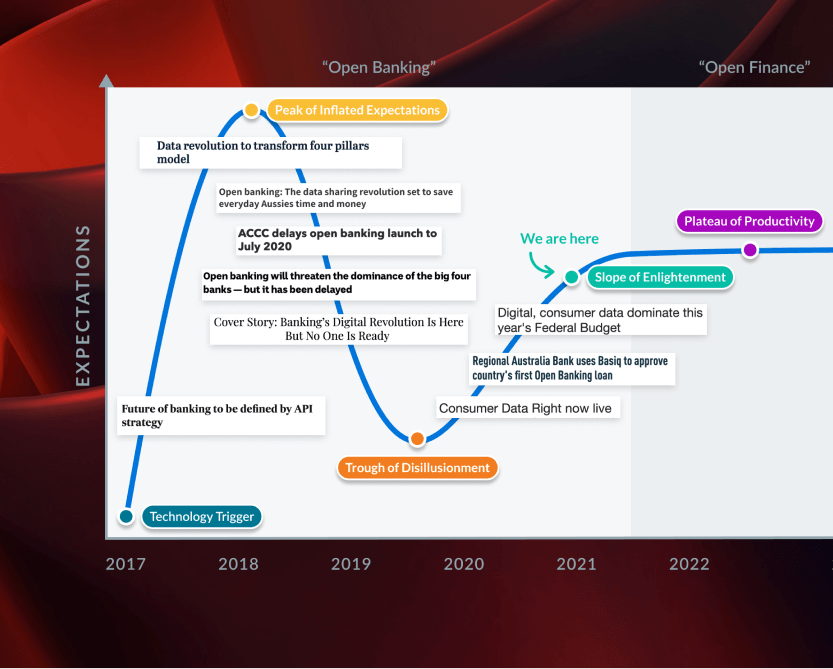
There is a lot of talk about how the Consumer Data Right (CDR) and Open Banking are performing and the majority of commentary is negative. We have found this public perception of Open Banking doesn’t align with our experience or the experience of our customers.

Basiq is one of the few data aggregators that offer both Open Banking and web scraping services. With a substantial user base across various use cases, Basiq can effectively measure the performance of Open Banking against the performance of web scraping. For the first time, we are sharing data from the Basiq platform to provide a different side of the story.

1. Open Banking has a higher growth rate than web scraping

  • Compounded monthly growth rate of Open Banking connections – 30%
  • Compounded monthly growth rate of web scraping connections – 4%

How?
Data from the Basiq platform shows that Open Banking is increasingly the preferred option for data access, with its growth rate now surpassing that of web scraping. Over an 18-month period, Open Banking connections surged from 10,400 in October 2022 to 777,000 in March 2024, resulting in a compounded monthly growth rate of 30 per cent. In contrast, web scraping connectors grew by only 4 per cent during the same period.

Why?
So, what’s the reason for the observed heightened growth? We attribute it to four key factors:

  1. The Government’s introduction of new CDR access models has reduced barriers to access for businesses
  2. An increase in the rate of significant data breaches among large corporate organisations
  3. Open Banking is a viable option for businesses previously unable to use web scraping
  4. Basiq enables customers to trial Open Banking before committing

2. Open Banking has a significantly higher connection success rate

  • Open Banking 80% Success rate – Failed connections are a result of invalid usernames/passwords, poor banking consent flow, CDR outages and potential fraudulent activities
  • Web Scraping 42% Success rate – The majority of failed connections are a result of invalid usernames/passwords

How?
It’s a common assumption that businesses lose more customers and, therefore, revenue using Open Banking over alternatives like web scraping when connecting customer bank accounts. The logic is that the friction caused by the length of the CDR data connection process results in consumers becoming frustrated and abandoning their attempt to connect their account/s.

Data from the Basiq platform shows the opposite is true. When comparing the success rate of connecting a customer’s bank account, Open Banking has a 80 per cent success rate versus 42 per cent for web scraping.

In essence, our data shows that businesses using Open Banking end up with more customers.

Why?
There are a number of events impacting the higher success rate of Open Banking versus screen scraping on the Basiq platform. These include:

  1. Consumer enters an invalid banking username or password
  2. Consumers don’t want to share their login or password details with a third-party
  3. Bank implements anti-scraping measures
  4. Planned maintenance of banking apps and online banking platforms

3. Open Banking is by far the more reliable option for ongoing connections

  • Failed connections after a 6 month period – 15% Web Scraping and 0.17% Open Banking

How?
For businesses requiring an ongoing connection to a consumer’s account, such as budgeting or investment apps, data from the Basiq platform shows that Open Banking is highly reliable.

Connection disruption can be a major issue for businesses, increasing the risk of customer churn. Consumers must complete the connection process again to establish a new connection.

Connection data across all customers on the Basiq platform indicates that 15 per cent of all consumers using web scraping will experience a disruption to their connection after six months On the other hand, connection rates using Open Banking remain consistent with less than 0.17 per cent likelihood of disruption.

Why?
Connection issues happen for a number of reasons including:

Web Scraping

  1. Consumer login details change
  2. Banks changing their UI or API
  3. Banks introducing anti-scraping measures

Open Banking

  1. Consumer revokes consent
  2. Consumer closes the connected account

Write access and the future of third party payment initiation

Basiq and Ernst and Young Australia have teamed up to write a comprehensive white paper looking at the future of Write Access in Australia.

It compares and contrasts two implementations of Write Access for third party payment initiation, proving that the Consumer Data Right is a world leading piece of legislation, drawing upon lessons from the UK and EU.

What are some of the key takeaways from the White Paper?

  • Payment initiation – The most common form of payment initiation is direct debit but this doesn’t leverage data to ensure payment success. Two new approaches have emerged to solve for this with the NPP & CDR Action Initiation.
  • Evolution of Open Banking – Open Banking enables consumers to freely share their consented financial data with trusted third parties. The CDR is currently predicated on ‘read access’ only.
  • Benefits of smart payments – The use of data in executing payments eliminates many issues currently faced with direct debits. These include the elimination of dishonour fees, avoiding failed payments and reducing the incidence of fraud.

Four new use cases for Open Banking’s future

The Australian Consumer Data Right (CDR) is designed as an exceptionally forward-thinking policy. However we are only scraping the surface of its potential.

This white paper takes a forward looking view at the Open Banking regime’s future, cemented in four novel use cases.

What are some of the key takeaways from the White Paper?

  1. Novel use cases – New use cases will emerge at the intersection of insights and action. These include Rules and event-based payment initiation, Dynamic credit risk decisioning and Autonomous personal finance.
  2. Towards Open Banking – Historically, consumers have only had the ability to interact with their data via technology known as ‘screen scraping’ but the roll out of Open Banking has accelerated.
  3. What the future holds – Open Banking will be bedded down over the next five years. As the CDR moves into other sector such as energy and telco, innovation will accelerate at an economy wide level.

Visualising an Open Finance ecosystem

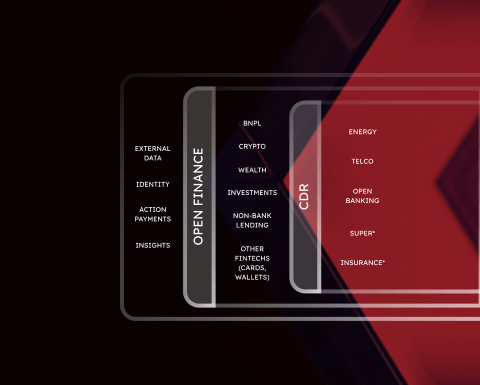
‘Open Finance’ is a term used to describe the accessibility of core financial services made available through APIs. This allows for the sharing of data across multiple financial institutions driven by consumer consent, as well as being able to do something with that data once shared, such as a payment.

The following white paper visualises what a truly Open Finance ecosystem looks like, with references drawn to Australia where necessary to add additional context.

What are some of the key takeaways from the White Paper?

  • Open Finance ecosystem model – An interconnected Open Finance ecosystem requires the core layers of Data, Insights and Actions. The proposed model outlines how the core layers interact with other inputs and outputs in the broader economy.
  • Open Finance components – There are four critical components that are required to create and enable an Open Finance ecosystem. This includes consent, data, insights and actions.
  • Benefits of Open Finance – While complex, Open Finance presents benefits to consumers including increased consumer empowerment, innovation and competition, increased financial literacy and consumer choice.

A practical guide to transitioning to Open Banking

As more financial institutions share data via Open Banking, there are specific requirements when it comes to both access and usage. Ensure you’re prepared for the transition by considering the key areas including your UX, Accreditation and Security.

Your handy guide + checklist and prepare for your transition to receiving Open Banking data

Accreditation

In order to use Open Banking under the Consumer Data Right, organisations must choose a pathway for participation in the CDR from a range of models. Which model is best for your organisation?

User Experience

Customer consent underpins the CDR, so the communication of consent along the customer journey is critical. Also what is the actual experience like when it transitions from your app to the banks’ app to sign in?

Security

The CDR sets out specific requirements on the level of security you need in order to be able to use Open Banking data. What documentation do you have and what controls are in place?

Beyond real-time: the value of pre-authorised payments from bank accounts

The face of payments in Australia has changed dramatically over the last twenty to thirty years, with the pace of change set to accelerate as technological advancements revolutionise the way we make, receive and request payments.

As the most frequently requested capability for the New Payments Platform (NPP), enabling the capabilities required to support third-party payment initiation from bank accounts has been a key priority for the payments and banking industry. Known as PayTo, this service will leverage the infrastructure of the NPP to drive the next phase of growth for the Platform.

PayTo will lead the use of embedded, pre-authorised payments from bank accounts in Australia, supporting a diverse range of payment use cases. It will provide consumers and businesses greater confidence, certainty and control over account-to-account payments as they are moved seamlessly into the background.

While PayTo will be available from mid-2022, when shifts in payment technology occur you want to be at the front of the queue to gain a first mover advantage over competitors. To help payment service providers and enterprises plan for the introduction of PayTo this white paper looks at:

  • The origins of real-time payments in Australia and the future directions for the NPP;
  • The rapid uptake of payment initiation in the UK under Open Banking;
  • The value PayTo will deliver to consumers and businesses and what the user journey looks like from the end-user perspective;
  • The role different participants play in the PayTo ecosystem; and
  • What Cuscal is doing to enable the PayTo services that are required by payer banks and payment initiators.

Format: White paper
Audience: Payment service providers and enterprises that process a large volume of payments
Estimated reading time: 20 minutes

Unlocking opportunities in the era of open data and payments

Under the government’s Digital Economy Strategy Australia is set to become “a leading digital economy and society by 2030”, with the Consumer Data Right (CDR) one of several initiatives designed to establish the right foundations to grow the digital economy.

Integrated data and technologies will make life easier for consumers and businesses, but enterprises face the challenges integrating legacy systems and infrastructure with real-time digital ecosystems. Cuscal can help enterprises bridge this gap, deploying new capabilities that support the collection, sharing, management and storage of consumer consent and CDR data. While our position at the centre of payments – as the leading provider of New Payment Platform (NPP) payment services to banks and payment service providers – means we are ideally positioned to help enterprises unlock new growth opportunities from the convergence of data and payment initiation services.

This white paper provides senior leaders and product owners with insights into some of the regulatory, technology, security and capabilities required to comply with the CDR today and how to unlock opportunities from the convergence of data and payments.

In this white paper you’ll learn more about:

  • What the CDR is, how it has evolved and what future legislative change may mean for Data Holders in designated industries, as well as for accredited Data Recipients;
  • How NPP capabilities are being enhanced and extended through the development of the PayTo service, supporting ‘write’ access for third party payment initiation from bank accounts in real-time, as envisaged under CDR;
  • What enterprises should consider to enable data-centric strategies that integrate with the CDR and real-time payments, and how Cuscal capabilities and payment expertise can facilitate participation across ecosystems;
  • Use cases demonstrating some of the ways in which the CDR and payment initiation can be applied to make life easier for consumers and businesses;
  • How Cuscal is assisting clients participate in the CDR with access to a suite of secure and robust capabilities for the collection, sharing, management and storage of data subject to CDR legislation; and
  • How Cuscal is enabling payment initiation services that are align with CDR and NPP PayTo frameworks for banks, payment service providers, fintechs and enterprises.

If you’d like to know more about how Cuscal can support your business participate in the CDR ecosystem and with real-time PayTo payment initiation, call 1300 650 501 or submit an enquiry.

Download the White Paper [PDF, 10 MB]

Get set for Open Banking

Image showing the KPMG, King & Wood Mallesons and Cuscal logos with the headline Open Banking

Open Banking is the first step towards an ‘open data’ future where organisations and people are all part of a robust ‘data economy’.

Open Banking is set to launch in Australia, which will see customers have greatly improved access to, and control over, their own data, all backed by the new Consumer Data Right (CDR). Open Banking is the first step in what will inevitably be an ‘open data’ future – in which institutions and customers are all part of a robust ‘data economy’.

In this Open Banking white paper Cuscal, KPMG and King & Wood Mallesons explore:

  • What lessons can be learned from international experiences
  • Why the customer should be at the core of any Open Banking-related strategy
  • The strategic opportunities Open Banking and open data present
  • The steps needed to be compliant
  • The partnership potential

Open banking specialists from Cuscal, KPMG and King & Wood Mallesons held a public webcast on Monday, 25 March 2019 to discuss the white paper and related open banking issues. The webcast features:

  • Bianca Bates, Chief Client Officer from Cuscal
  • Nathan Curchward, Head of Product, Emerging Services from Cuscal
  • Scott Farrell, Partner from King & Wood Mallesons
  • Ian Pollari, National Sector Leader, Banking and Global Co-leader from KPMG Fintech practice

A recording of the webcast is available. It is recommended for financial institutions, fintechs and other organisations that want to take advantage of the opportunities Open Banking offers, while meeting the compliance obligations.