Skip to Content

Cuscal appoints Bianca Bates as Chief Client Officer

Picture of Bianca Bates, the new Chief Client OfficerCuscal has appointed Bianca Bates to the role of Chief Client Officer, as part of Cuscal’s Leadership Team. This role replaces the role of General Manager, Product & Service, which Bianca has been acting in since February 2018.

Commenting on the appointment, Cuscal Managing Director Craig Kennedy said:

The Cuscal Board has confirmed Bianca’s appointment after an extensive search for the right candidate. I’m delighted that Bianca was successful and will continue her career at Cuscal after her success in previous roles over the past four years.

The change in title reflects our commitment to partnering with our clients and delivering a great client experience. Bianca brings significant experience in financial services and our business to this role, including, crucially, a great understanding of the needs of our clients.

Bianca has held a number of senior roles at Cuscal since she joined, including Acting General Manager, Product & Service, General Counsel & Company Secretary, Acting General Manager Shared Services and Head of Client Services. She has over 20 years’ experience in financial services with large and complex US and Australian companies, both public and private. Prior to Cuscal she worked in senior legal and compliance company secretariat roles with Genworth, GE Capital and DLA Phillips Fox.

Aussies want to pay with their phones

A person paying a merchant with their phone

In the highly competitive environment of consumer banking, finding comparative advantage over major players is a rare opportunity. However, recent research by Telsyte shows clearly that the reluctance of major banks to adopt digital wallets such as Apple Pay, Google Pay (formerly Android Pay) and Samsung Pay has created an opportunity for those institutions who have led the way in offering their customers more choice in the way they pay.

Aussies will move banks to pay with their phones or wearables
Recent research shows that mobile and wearable payment solutions like Apple Pay, Google Pay and Samsung Pay are increasingly influencing consumers’ choice of financial institutions.

The Telsyte study found that around one in five (22 per cent) iPhone users claim they are more likely to bank with a provider if it supports Apple Pay. This figure increases to 32 per cent for those who are also using an Apple Watch. This research shows a clear opportunity for financial institutions to differentiate from the major banks to acquire new customers – particularly those using Apple devices.

Mobile payments are growing in Australia
Although the number of payments made by mobile devices is still comparatively small, the use of mobile payments is growing quickly year on year. The RBA reported in its 2017 Consumer Report that only 2% of consumers had used a smartphone, watch or band to make a payment. This figure has grown exponentially to 14%, according to Telsyte’s study in 2018. This could be due to increasing understanding amongst consumers that mobile payments are more secure than Tap & Pay cards, which I discussed in my recent article on digital wallet security.

Other key takeaways from Telsyte’s research that have implications for financial institutions that are considering offering mobile payments to their customers include:

  • Smartphone sales were up 11% year on year, 9.2 million units sold in 2017
  • There are 19.3 million smartphones in circulation in Australia
  • Android/Google based smartphones made up 55% market share, Apple with 45%
  • Growing price is being driven by need for greater internal storage (supporting greater capabilities and use)
  • 85% of consumers replace an Apple iPhone with another iPhone, Samsung at 70%
  • For the first time, more smartwatches were sold than smart bands in 2017 (58% v 42%)
  • Apple watches lead the smart wrist wearables market in Australia, with now over 1 million Apple smartwatches in the country. FitBit were the leader in smart band devices

We were an early partner and adopter of mobile payment solutions, offering Apple Pay, Google Pay and Samsung Pay to our clients. At Cuscal we support over 41 financial institutions offering Apple Pay, Google Pay and/or Samsung Pay to their customers.

By Trent Gunthorpe, Head of EFT, Acquiring and Digital

NPP launches with 60+ finance brands, 40 via Cuscal

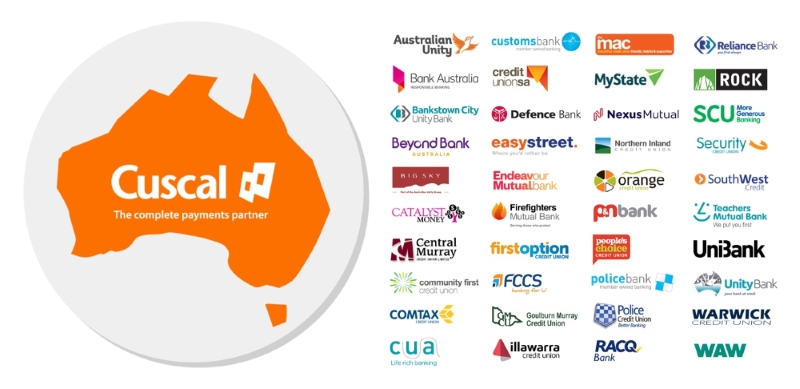
The New Payments Platform (NPP) was made publicly available today with customers of more than 60 banks, credit unions and building societies now able to receive real-time payments. 40 of these are connecting via Cuscal, greater than 50% of the total, and we will be connecting more later this year.

Financial institutions will roll out NPP services in their own time. Most of our clients have full functionality now (including registering a PayID and making and receiving payments via Osko) others will roll things out more slowly, in the coming days, weeks and months. New Payments Platform Australia (NPPA) estimates that 4 out of 5 Australian bank accounts will be able to accept NPP payments within a few weeks of launch. All participating financial institutions are listed on the NPPA website.

Commenting on the launch of the NPP, Cuscal MD Craig Kennedy, said:
“Today really is a landmark day for banking and payments in Australia; the launch of a totally new infrastructure for payments happens very rarely. We’re delighted that we’ve been able to play a key role in the build and launch of the New Payments Platform and that so many of our clients can share this great day with us.

Australians have been rightly annoyed that it took so long for money to move between accounts at different institutions. Now, for customers at forward-thinking financial institutions that’s a thing of the past. It just goes to show that no matter how large or small your financial institution is, it can give you the latest and greatest payment innovations just as quickly as the biggest banks in Australia.”

The NPP is a brand new infrastructure for payments which has been collaboratively developed by 13 financial institutions, including Cuscal, to make payments faster, simpler and smarter for all Australians. These financial institutions mutually own New Payments Platform Australia Ltd (NPPA) which is responsible for building and operating the NPP. Cuscal MD Craig Kennedy sits on the board of NPPA.

The finance brands now connected to the NPP via Cuscal are:
List of financial institutions Cuscal is connecting to the New Payments Platfrom from launch

Media contact
Jake Waddell jwaddell@cuscal.com.au 0417 312 902

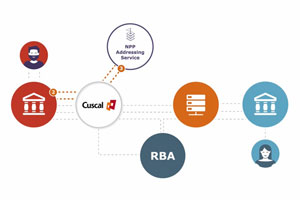
How the New Payments Platform works

This animation shows what happens when you make a real-time payment between two accounts at participating financial institutions, using a simple to remember PayID.

When payments are sent using a service like Osko by BPAYTM, which is designed to work seamlessly with PayID, over 99% of payments will be completed in under a minute and most within 15 seconds – providing customers with a quick and easy way to transfer money between accounts at participating financial institutions there from launch.

We are connecting more organisations to the NPP than anyone else – more than half of all those who will be live on Day 1.

Learn more about connecting to the NPP with Cuscal.

How fast is the New Payments Platform?

Cuscal is proud to be one of the financial institutions bringing the New Payments Platform (NPP) to Australia.

This video demonstrates just how fast a payment on the New Payments Platform is. It shows a live payment between an account at Teachers Mutual Bank account and SCU, using a mobile phone number as a PayID instead of a BSB and account number.

Using Osko® on the New Payments Platform, over 99% of payments will be completed in under a minute, most within seconds – giving people a quick and easy way to transfer money between accounts at participating financial institutions.

We are connecting more banks, credit unions and building societies to the New Payments Platform than anyone else – more than half of those using the NPP from day 1.

Learn more about connecting to the NPP with Cuscal.

Apple Pay coming to eftpos for Cuscal sponsored FIs

apple pay is now available for eftpos cardholders

Sydney, 6 February 2018: eftpos, Australia’s own debit payments network, today announced eftpos-only cardholders from six Cuscal sponsored financial institutions can now use Apple Pay, which is transforming mobile payments with an easy, secure and private way to pay that’s fast and convenient.

eftpos Acting CEO, Mr Paul Jennings, said that leading independent payments company Cuscal has worked with eftpos to enable six financial institutions to launch eftpos for Apple Pay today, offering their eftpos cardholders the choice of using Apple Pay with eftpos.

The Cuscal sponsored financial institutions include CUA, FCCS, Nexus Mutual, People’s Choice Credit Union, SCU More Generous Banking, and Woolworths Employees’ Credit Union.

Mr Jennings said Apple Pay with eftpos will provide eligible eftpos cardholders with the ability to make eftpos purchases on their iPhone or Apple Watch using their own money, processed in real time.

Security and privacy is at the core of Apple Pay. When you use an eftpos card from participating financial institutions with Apple Pay, the actual card numbers are not stored on the device, nor on Apple servers. Instead, a unique Device Account Number is assigned, encrypted and securely stored in the Secure Element on your device. Each transaction is authorised with a one-time unique dynamic security code.

“Today marks another significant milestone for eftpos as we enable more consumers with an iPhone or Apple Watch to choose eftpos to make a transaction from their CHQ or SAV account,” Mr Jennings said. “As Australia’s most used debit card network, we are thrilled to provide consumers from these participating financial institutions with more payment choice, with added benefits of enhanced security and convenience.”

In stores, Apple Pay works with iPhone SE, iPhone 6 and later, and Apple Watch. To set up Apple Pay, cardholders from participating banks and credit unions simply need to open the Apple Wallet app in iOS 11 and follow the prompts.

Cuscal’s General Manager Product and Service, Robert Bell said: “Tens of thousands of eftpos cardholders can now pay with their iPhones, providing greater choice for our clients’ customers. We provide leading digital payment solutions to our clients, helping them to compete on a more level playing field with the big banks.”

For more information on Apple Pay, visit: http://www.apple.com/au/apple-pay/

This press release was originally published by eftpos.

About eftpos
eftpos is the most widely used debit card system in Australia, accounting about 2 billion CHQ and SAV transactions in 2017 worth more than $130 billion. For more information on eftpos, please visit: www.eftposaustralia.com.au

About Cuscal
Cuscal is Australia’s leading independent provider of payment solutions including card and acquiring products, mobile payments, NPP, fraud prevention, EFT switching and direct entry. We process 14% of Australia’s EFT transactions, have over 7.5 million cards under management and switch and acquire for around 35% of Australia’s ATMs. W: www.cuscal.com/ L: www.linkedin.com/company/cuscal

Media inquiries:

Warwick Ponder, eftpos
0408 410 593
WPonder@eftposaustralia.com.au

Jo Savill, Cuscal
0447555018
jsavill@cuscal.com.au

Smartphones – high security digital wallets

Customer paying with a digital wallet on a smartphone

When it comes to purchase convenience and security, Tap & Pay cards are the current leaders. But it is becoming clear that digital wallets are in the running to replace them. It is no longer a matter of “if” but “when”, with today’s announcement that eftpos cardholders can now use Apple Pay, adding to the suite of card schemes available on digital wallets. In addition to the convenience and ease-of-use benefits of digital wallets, it’s their cutting-edge, multi-layer security that makes them the better and safer option for payments.

However, surveys consistently show that customers are concerned about the safety of digital wallets. This concern arises in part from poor communication on how digital wallets are implemented and how they work. Digital wallets were designed to address the security flaws in cards and create a more secure payment method. They are safer than cards, by design, and their security starts with the smartphone.

The multi-layer security of the digital wallet
The security advantage digital wallets have over cards begins with their access to the computing power and features of the smartphone, including specialised security hardware for protecting personal information. This gives the digital wallet app secure storage for payment information where other apps or malware cannot access it.

  1. The first layer of security in a digital wallet comes into play when cards are added to the digital wallet app. Cards can be added using the phone’s camera, typing them in, or transferring them directly from some financial institutions’ apps. The app requires that the person adding the cards is verified as the owner of the cards before they can make payments. This may involve a one-time password sent via SMS to the phone or via email, or even a quick chat with customer service.
  2. The second security layer is the customer and how they control access to their phone. That control can be a PIN or pattern passcode, and, on more recent smartphones, biometric verification using their fingerprint, face or eyes. If the phone is lost, no one can use its digital wallet to make purchases without passing verification. However, for ease of use, some digital wallets do allow the customer to make small purchases without unlocking their phone.
  3. The third layer of security is called tokenisation. To increase transaction security, digital wallets do not store card details or share them when a payment is made. Instead, a token is generated when a card is added. This token is transmitted instead of the card details when a payment is made.

The token is a unique number that links the card to the customer’s device and digital wallet. This allows a customer to register the same card on multiple devices and with multiple digital wallet providers. It is generated by the payment infrastructure provider used by the digital wallet. The payment infrastructure provider stores the original account information on a heavily secured system called a Token Vault.

When a transaction is made the token is used by the payment processor to retrieve and verify the original card information from the Token Vault and complete the transfer of funds. The merchant never sees the actual card details and the account information never travels outside of secure networks. An additional benefit of tokenization is if the user loses their phone they do not need to cancel their card, but they do need to lock or remove the card from their digital wallet. Digital wallet providers have online services to do this in the event of a lost phone.

Finally, digital wallets are protected by the same 24/7 computer-based fraud monitoring and zero liability protections as Tap & Pay cards.

More than POS payments
Digital wallet providers are actively expanding the functionality of their apps. Digital wallets can be used to make purchases within apps and for online purchases. Some digital wallets can automatically provide your delivery address as part of an online transaction. The digital wallet may also store loyalty cards, event tickets and boarding passes that can be scanned from the screen of the phone.

As more transaction types are handled by digital wallets their use will continue to grow. With that growth will come a demand for financial institutions to offer their customers access to the digital wallet provider of their choice. Banks that won’t or can’t will lose customers.

Transitioning to digital wallets
Customers are already choosing financial institutions that are compatible with their phone and digital wallet provider. This is a clear signal that the technology is proven and spreading from early adopters to the mainstream. At the same time, the back office technology has been tried and tested. Deploying digital wallet services is now easier than ever.

Today or tomorrow, your customers are going digital. Be there for them. Find out more about our digital solutions.

By Trent Gunthorpe, Head of EFT, Acquiring and Digital

Fraud and AI: what you need to know

Artificial Intelligence (AI) is already having a significant impact on the way we do business today. From helpful chat bots guiding us through complex purchase journeys to detecting potentially fraudulent payments, AI has the potential to create seamless customer experiences while simultaneously processing large amounts of information.

Machine learning frees humans from the grunt work of data tracking and pattern analysis – it’s faster, more scalable and learns from past information. No wonder Gartner predicts that more than 40% of data science tasks will be automated by 2020.

So when it comes to balancing customer demand for real-time payments with secure fraud-mitigating authentication, AI is an effective enabling tool for fraud teams to focus their investigation skills in the best place to securely ensure the speed and rigour required for a real-time payment. And that’s why more organisations are exploring the use of AI, especially in the area of fraud.

What role could AI play in fraud prevention and detection?

Through machine learning, the complexity of big data really becomes useful. At Cuscal, we have partnered with Feedzai to provide an advanced risk management platform that will be core to protecting Cuscal clients from the evolving threat of fraud.

“When using Feedzai, banks have significantly improved fraud detection, reduced false positives and overall a better customer experience – outperforming leading non-AI solutions – that’s why banks like Citi and Capital One have backed Feedzai’s technology.” said Richard Harris, SVP Sales International from Feedzai.”

With so many more payment channels available – online, mobile, P2P – there are more points of vulnerability. More than ever, we need a complete view of customer activity across products, an integration of channels to improve the customer experience, and to make more data-backed business decisions.

How will AI strengthen existing fraud protection systems?

With AI’s ability to analyse complex data in real time, fraud teams are better equipped to predict fraud before it occurs and so minimise losses.  AI reduces some of the noise of large amounts of data to focus on the real threats.  As we prepare to launch the New Payments Platform (NPP) in Australia, we can expect to see digital transaction processing converge with analytics providing better insights. Machine learning will enable organisations to look at more data, from more sources, and make better predictions with less uncertainty.

Of course, bots could be working on both sides – and the next generation of AI-enabled fraud systems will also need to be prepared to tackle new and increasingly sophisticated fraud attempts and scams.

Every Australian financial institution connecting to the New Payments Platform (NPP) needs to consider their real-time fraud monitoring and ensure effective controls are in place. AI is likely to underpin best practice – checking every transaction in real time for anomalies and flagging suspicious activity for action by experienced fraud investigation teams.

Learn more about preventing fraud in a real-time world.

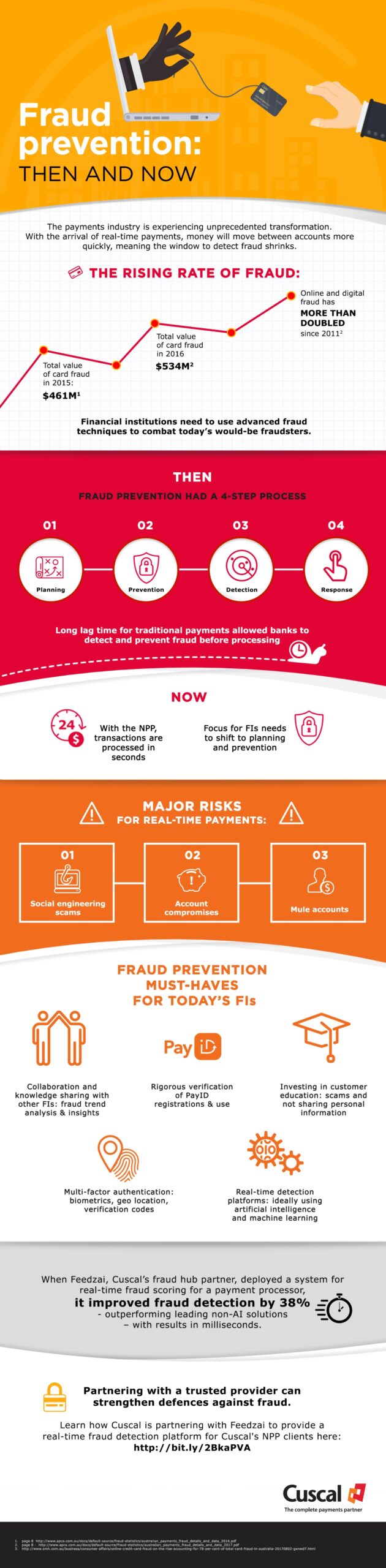
Fraud prevention: then and now

Fraud & AI Infographic

Learn more about preventing fraud in a real-time world.

By Michelle Trundle, Senior Manager, Fraud

Teachers Mutual Bank rolls out Cuscal mobile app

person using TMB mobile banking app, developed by Cuscal

Sydney, 7 November 2017 – Over 100,000 Teachers Mutual Bank members will be upgrading to a brand new digital platform, provided by Cuscal.

With a focus on member needs, the new Teachers Mutual Bank app will ensure members have convenient and easy access to a host of service features including the capacity to: block/report a lost/stolen card and change card PINs and access to increased security features.

“The new Teachers Mutual Bank mobile app empowers our members, giving them access to a wide range of features now; and provides us with the infrastructure to create innovation in the future,” stated Teachers Mutual Bank Limited’s Chief Sales and Marketing Officer (Acting), Gerard Smith.

“We have already been recognised as a leader in the financial services industry for customer service^. This new app builds on that reputation, giving our members access to banking functions more commonly associated with branch service, than self-service,” said Gerard Smith.

Cuscal worked with Teachers Mutual Bank, including several rounds of customer testing, to ensure that the app met the needs of the bank’s members.

”Cuscal helps financial institutions like Teachers Mutual Bank to compete with larger banks by providing great technology, which their customers really value,” said Cuscal’s Senior Manager Acquiring & Digital Solutions, Valentina Dunoski.

“With the launch of Teachers Mutual Bank’s app, there are now 22 brands using Cuscal’s white-label banking app – a number that has doubled in the past year and continues to grow. We also offer a growing suite of APIs, which financial institutions can plug into, as well as our other products like the New Payments Platform (NPP),” said Valentina Dunoski.

The rollout of the new Teachers Mutual Bank mobile application futureproofs the bank’s digital offering and will provide a platform for further innovation.

“The new app is a great platform, but over the next few years we want to go further. The next stages of our digital initiatives will give us a critical edge in a highly competitive banking market,” stated Gerard Smith.

Teachers Mutual Bank’s new mobile app can be downloaded for Apple devices from the App Store, and for Android devices from the Google Play store.

Media Contact
Jo Savill jsavill@cuscal.com.au 0447555018

*‘World’s Most Ethical Companies’ Award, from Ethisphere Institute. (Awarded, 2016, 2015, 2014)
^ Teachers Mutual Bank led Australia’s Top 15 consumer banks on customer satisfaction rates for Jan-Jun 2017, see Roy Morgan Research

Cuscal connecting over 50% of FIs to NPP

Person using the NPP to make an instant payment

Sydney, 26 October, 2017 – Today, the New Payments Platform (NPP) took an important step closer to an early 2018 launch as we passed a major checkpoint on the road to going live.

Each of the 13 shareholders of the NPP Australia Ltd has revealed which banks, credit unions and building societies they would be bringing live on Day 1. 29 financial institutions covering 39 retail banking brands will be connecting to the NPP from Day 1 via Cuscal – more than 50% of the total number.

Robert Bell (General Manager, Products and Service), said:

“Today is a significant milestone for Cuscal and our clients. Building the NPP infrastructure and then connecting to it has been a large and complex undertaking for everyone involved, no matter how big they are, so to pass these milestones is cause for celebration. We are very proud to be connecting such a large percentage of all financial institutions. It’s a real credit to the fantastic work of our Cuscal NPP Team and their counterparts at our clients and their core banking system providers.

“It demonstrates that large, medium and small financial institutions can all have access to the latest and greatest payment technology. Some of our clients connecting to the NPP have millions of customers and others have thousands, but all of them will be able to make and receive payments in real-time from the first day the NPP is publicly available.”

The list of financial institution brands connecting to the NPP via Cuscal at launch includes:

Bank Australia, Beyond Bank Australia, Big Sky Building Society, Australian Unity, Central Murray Credit Union, Catalyst Money, Illawarra Credit Union, Community First Credit Union, Easy Street Financial Services, Northern Beaches Credit Union, CUA, Credit Union SA, Defence Bank, First Option Credit Union, Ford Co-operative Credit Society, Goulburn Murray Credit Union, MyState, The Rock, Nexus Mutual, Orange Credit Union, P&N Bank, People’s Choice Credit Union, Police Bank, Police Credit Union, RACQ Bank, Comtax Credit Union, Security Credit Union, SCU, Select Encompass Credit Union, South West Credit, Firefighters Mutual Bank, Teachers Mutual Bank, UniBank, The Mac, Bankstown City Unity Bank, Reliance Bank, Unity Bank, Warwick Credit Union, WAW Credit Union.

Media contact
Jake Waddell jwaddell@cuscal.com.au 0417 312 902