Skip to Content

Global Payments Innovation Playbook

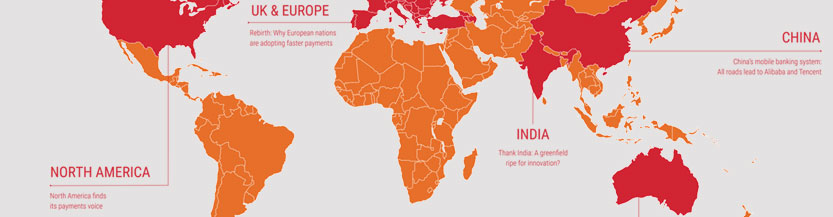
The Global Payments Innovation Playbook is a collaboration between PYMNTS and Cuscal to examine the key pillars driving financial innovation in Australia, China, the European Union, India, the United Kingdom and the U.S. We have curated some of these regions’ most promising and impactful innovations in this report, all to disseminate the important lessons local success stories have to teach.

The playbook offers a glimpse into global innovators’ efforts to take eCommerce and mobile payments to new heights. This includes what they can show us about modern consumers’ shopping habits, and how businesses might incorporate other regions’ successes when looking to expand abroad.

Contents of playbook:

  • Executive summary
  • Rebirth: why European nations are adopting faster payments
  • North America finds its payments voice
  • China’s mobile banking system: All roads lead to Alibaba and Tencent
  • Thank India: a greenfield ripe for innovation
  • Australia’s new real-time payments environment

Unlocking the potential of real-time payment


A discussion on unlocking the potential of real-time payments with Adrian Lovney (NPPA), John Banfield (BPAY), our own Nathan Churchward & Phillip Finnegan (ACI Worldwide) at Curious Thinkers 2018 in Sydney.

Watch the video to see the panel discussion into the potential of real-time payments, as well as covering the competitive landscape, fraud and NPP access.

Faster Payments, Richer Data with Adrian


Adrian Lovney, CEO, NPPA at Curious Thinkers 2018 in Sydney providing Cuscal’s clients with information about faster payments and richer data.

Watch the video to learn the current status of the New Payments Platform as well as its plans and priorities for the future. Adrian delves into the NPP’s API plans and its ‘consent and mandate’ service which will lay the groundwork for servicing direct debits as well as the second phase of Osko ‘request to pay’.

Nice digital identity – now what? with Steven


Steven Bankston, Visa’s Senior Director of Product Development, talking to Cuscal’s clients about digital identity at Curious Thinkers 2018 in Sydney.

Watch the video to learn about the complexities and challenges of digital identity. What it is and how is it formed. Steven shares what we can learn from GDPR and PSD2 and the different regulatory challenges in this ever-evolving, global issue. He also discusses how collaboration can help financial institutions and others capitalise on the opportunities digital identity brings.

Bendigo Bank: from innovation to incubation

Andrew Twaits, Executive, Customer and Partner Engagement at Bendigo and Adelaide Bank presented “Bendigo Bank: from innovation to incubation” at Curious Thinkers 2018 in Sydney.

Watch the video to learn how Andrew drew on his experience in the online gambling industry, along with his work in the banking sector, to build great customer experiences. He covers why customer experience matters; disruption; timing; awareness & focus.

Youthquake 4.0 with Rocky Scopelliti


Rocky Scopelliti, Author & Futurologist at Curious Thinkers 2018 in Sydney talking to Cuscal’s clients about Youthquake 4.02 – a whole generation and the new industrial revolution.

Watch the video to find out about the different characteristics millennials have from other generations in relation to digital technology. How this informs everything they do and the opportunities and threats that this presents for organisations that align their businesses to this influential new generation.

Unlocking growth through innovation with Charlotte

Charlotte Rush, Innovation Consultant, Inventium at Curious Thinkers 2018 in Sydney talking to Cuscal’s clients about how to unlock growth through innovation.

Watch the video to learn insights on the difference between true innovation (which adds value) and change for change’s sake (little value). In addition, learn the importance of identifying consumer frustrations to unlock opportunities for innovation.

P&N Bank launches instant digital cards

People using mobile phones

P&N Bank is Cuscal’s first client to launch instant digital cards, using the Cuscal Virtual Card API set. The APIs allow companies to provide their customers with new or replacement digital cards into their mobile wallet within seconds. Without a digital version of the card, customers can be without access to their money for days or even weeks.

Cuscal’s Virtual Card APIs are the most comprehensive instant card issuance solution in Australia. No other financial institution in Australia currently provides instant card issuance for new and replacement cards and gives its customers access to the full virtual card to allow online payments.

Instant access to the full card number is particularly useful as it not only allows customers to pay for things in person, but also buy things online. This is particularly useful for customers who are travelling and their cards are lost or stolen. They can simply log into their mobile banking application or internet banking, order a new card and continue their holiday uninterrupted.

Cuscal Head of EFT, Acquiring and Digital Lauren McCormack said Cuscal was thrilled to have been able to help P&N Bank deliver this great advancement to its mobile and digital banking capability.

“We see it as a real win-win for both P&N and its customers, saving time and money for everyone involved. We also hope that it will help P&N Bank customers get access to their money more quickly and easily in those awful, stressful situations we all find ourselves in when our cards are lost or stolen,” she said.

Not only does instant card issuance have great customer benefits, it is also very useful for financial institutions and other companies that issue cards. They can save money by not needing to physically mail out PINs to their customers and also start earning revenue sooner by giving customers quicker access to their money. In the future, companies may decide to save even more money by not issuing physical cards at all.

Financial institutions and their customers can realise even greater benefits if they combine Cuscal’s Virtual Card API with the Card Control API. Financial institutions can decide to enable controls on a card (eg restricting spend for instore/contactless payments) until the physical card has arrived with the customer. This reduces the chance of someone intercepting a card while in the mail and then being able to make fraudulent payments.

Cuscal’s solution currently works for Visa and eftpos credit, debit and prepaid cards. Cards can be ‘provisioned’ (enabled in a mobile wallet) to Apple Pay, Google Pay and Samsung Pay. The solution also works for any cards making payments via eftpos and Visa, companies do not need to be current clients of Cuscal to make use of the API’s capabilities.

Everyone wins when you enhance a banking app

People using their phone while waiting for a train
Times have changed. It’s now normal for consumers to buy their groceries, clothes and travel, read news, socialise and research major purchases via their phones. Even essential government services like Centrelink and Medicare are encouraging their customers to use their digital channels rather than face-to-face contact. Financial institutions must also provide opportunities for customers to complete more of their banking via digital channels.

A recent McKinsey and Company report[i] shows that customers across Asia – including Australia – have made a clear shift to digital banking in line with smartphone usage.

Mobile banking is now the preferred option for standard banking transactions such as checking account balances and paying bills. The report highlighted that deep digital engagement with customers can generate considerable value for banks: digitally active customers are stickier – they purchase 1.6 products per year, compared to 0.5 on average for non-digital customers; and active digital customers also own 1.5 times more banking products than their non-digital peers.

Enabling digital engagement at the front-end, where consumers interact with their bank’s services, is a crucial part of developing digitally active customers. Banking apps that are easy to navigate and rich in features provide a myriad of benefits to customers – and ultimately to financial institutions too.

Driving engagement with card and PIN controls

You can improve the richness of your existing digital channels, like banking apps, by introducing new functionality. This can increase your customers’ ability to self-service, encouraging ongoing, regular use of your banking services and improving their loyalty to your brand.

For a customer managing their banking, the ability to manage their card PIN through their banking app – rather than having to make time to visit the branch – is a perfect example of how a banking app which is rich in functionality can better meet customers’ needs. Indeed, for a customer with a crisis out of hours where they need money and have forgotten their PIN, the ability to take control and solve the problem themselves, using their banking app, can be an instant stress reliever.

Implementing enhanced card controls within a banking app is another great way to engage customers by giving them the tangible benefit of real-time management of their cards. Allowing customers to turn certain transaction types on and off with a swipe of their finger, or activate limit-based transaction blocks, creates both financially savvy and digitally engaged customers.

Enabling or disabling contactless payments, switching online or card not present transactions on and off, activating or de-activating ATM transactions (for domestic or overseas transactions) are all examples of everyday interactions banks can create for customers within their banking app. Some customers are asking for further controls, such as setting blocks on merchant categories and being notified when transactions are approved or declined.

Benefits for financial institutions

There is benefit for banks in moving functionality into online or digital channels.

Empowering customers to self-serve helps to lower cost-to-service metrics and enables customer service staff to focus on other priorities and higher value transactions.

Using a banking app as a delivery channel can help solve pain points for both customers and financial institutions. A good example of this is the emergence of virtual card capabilities, to support instant card issuance. This technology allows a financial institution to digitally issue a card to a customer via their banking app or internet banking platform. The customer receives their digital card almost immediately after the order is processed. They can set their PIN, activate the card and use it online straight away. The card can also be provisioned to a digital wallet such as Apple Pay, Google Pay, Samsung Pay or a wearable like Fitbit Pay or Garmin Pay, and be used straight away, anywhere contactless transactions are accepted. No more waiting for several days for the plastic card to arrive before you can start spending.

Instant card issuance is a win for both institutions and customers. The financial institution earns transaction revenue sooner than with the traditional card and PIN ordering process, and saves money because plastic cards and PINs don’t need to be created or sent to customers. Cardholders benefit as they no longer need to worry about their PIN falling into the wrong hands, or wait for their card to arrive before spending in stores or online.

Your best friend when disaster strikes

Digitally issued cards also go a long way to solving the lost card problem – because there isn’t a card to lose! And a virtual card on the phone, even if it is lost, is protected by the phone’s security.

And finally, if a customer loses their physical card – especially if they are travelling – being able to issue a virtual card instantly means that the customer isn’t stranded. It’s conceivable that they could lose their plastic card at breakfast on their last day, login to the app, cancel the old card and set up a new virtual card on their phone in time to check out of their hotel and go to the airport.

Without instant card issuance, the customer could have been stranded for days, or even a week.

At Cuscal, we are collaborating with our clients to help them offer engaging and innovative banking experiences to their customers. Our current suite of products is designed to promote efficiencies in banking operations and create self-service opportunities for cardholders. Our API suite includes enhanced card control APIs, PIN management APIs (including PIN change and PIN set functionality) and a virtual card set to facilitate instant card issuance.

These are dynamic times for financial institutions and we are excited to be assisting our clients to develop solutions that support a more digital way of banking.

By Lauren McCormack, Head of EFT, Acquiring and Digital

[i] Sonia Barquin, Viniyak, HV, Duhita Shrikhande, Asia’s digital banking race: giving customers what they want, McKinsey & Company, Global Banking Practice, April 2018


Cuscal hits female leadership targets

Cuscal's female leadership with MD Craig Kennedy

A gradual increase in the number of senior female appointments in recent years has helped Cuscal to hit its target of 40% of senior leadership roles to be held by women.

In May this year Helen Mediati, Cuscal’s General Counsel and Company Secretary was appointed to Cuscal’s Leadership Team. This followed the appointment of Bianca Bates to the role of Chief Client Officer, earlier the same month. Cuscal’s Managing Director, Craig Kennedy, says it has been a deliberate part of Cuscal’s long-term strategy:

“Cuscal is a payments company which straddles the worlds of technology and banking, both industries which struggle with gender diversity and female leadership.

We knew that having greater gender balance in our leadership would help make us a stronger, fairer, better company, so we have been working towards a goal of greater senior female leadership for a few years now. Three out of seven of my Leadership Team are now women (43%) and this ratio is consistent throughout leadership positions at Cuscal.

We know there’s still some way to go, for example our diversity at Board level isn’t what we would like it to be, but we’re pleased to hit this target and now need to maintain or improve it.”

Cuscal has employed a range of initiatives to improve diversity, female employment and leadership at Cuscal which include:

  • Creating a Women’s Initiative Network three years ago and then a Diversity and Inclusion Council
  • Mandating that recruiters include at least one suitably qualified female applicant for each role
  • Trialling blind resumes in the project and technology division
  • Reviewing our flexibility policies to ensure consistency in application
  • Extending paid paternity leave from one week to four weeks.

As of May 2018, Cuscal’s ratio of male/female employees was:

  • Board: 13% female, 87% male
  • Leadership Team: 43% female, 57% male
  • All employees: 40% female, 60% male

Pictured L to R: Bianca Bates, Craig Kennedy, Helen Mediati, Christie Welsh