Skip to Content

Preventing fraud in a real-time world

People making instant payments with their phones

When the New Payments Platform (NPP) arrives, it will position Australia as a global leader in real-time payments. As exciting as that is, as a financial institution there are an array of practical considerations that you need to take into account. Key among them is managing the potential for fraud.

While fraud prevention may seem like a daunting task, in Australia we are well positioned to do so. Our existing services, such as “pay anyone,” are already well established, and we lead the world in smartphone adoption. That’s significant because smartphones offer greater opportunity for security and identification, including in-app messaging and biometrics.

We also have the benefit of being able to draw on key learnings from those who have gone before us in real-time payments. By studying the experiences of countries like the UK, for example, we can glean important insights and apply them here.

In this paper, we will outline the key considerations that you need to be aware of around fraud and explain what the NPP and Cuscal are doing to help prepare.

The reality is that although the NPP isn’t inherently riskier than our current payments system, you still need to be vigilant. Fraudsters are always looking for new opportunities to make money, so they could be waiting for the NPP to go live to try to test how secure it is.

To minimise that potential risk, it’s essential that you are ready when the NPP goes live.

Contents of the whitepaper:

  1. Lessons learned from the UK’s Faster Payments Service
  2. Understanding the threat
  3. Addressing the problem of fraud and real-time payments
  4. Spotlight on artificial intelligence and fraud prevention
  5. Moving ahead with the NPP with confidence

4 ways financial institutions are preparing for the NPP

People sitting in a row using digital devices

What happens when payments are as easy and immediate as sending a text message? While the digital opportunities of Australia’s new super-fast payments system are exciting, its speed may also increase the potential risk of fraudulent transactions. The NPP (New Payments Platform) isn’t more vulnerable to security breaches, but banks will no longer have the luxury of time to detect and respond to fraudulent or suspicious transactions.

And that’s why Australian financial institutions are already preparing for NPP – by shifting their risk focus to planning and prevention.

The NPP is a platform that enables real-time clearing and settlement for simple or complex payment solutions, between two people or between many. When it launches next year, almost all Australian bank account holders will be able to make and receive payments in seconds.

The promise of bank transfers clearing almost instantly – even on bank holidays and weekends – is alluring for consumers, business and government. But when payments happen faster, there won’t be time for our tried and tested detection processes. Based on the UK’s experience with its Faster Payment Service, the most common risk is likely to be social engineering scams, where fraudsters convince a customer to make a payment by posing as a trusted brand. Account compromises and mule accounts (for money laundering) are other possible fraud issues.

Any financial institution connecting to the NPP will need to have real-time fraud detection and response controls in place.

As one of the primary architects of the NPP, Cuscal is working with more than 30 financial institutions to securely connect to this game-changing banking infrastructure. Here are four ways we’re working with our clients to get ready.

1. Preparing for PayID verification. 

Forget BSBs and account numbers – with the NPP, bank accounts can be linked to the customer’s email address or mobile phone number. Easier to remember, these PayIDs are directly associated with the actual account name so there’s less risk of paying the wrong person. While this will help ensure payments go to the right place – it will also impact current payment verification protocols.

Financial institutions are responsible for registering customer information in PayID, and may be liable for any loss that results from incorrect or fraudulent data input. That’s why the account name associated with the PayID is an important control checkpoint and one banks need to pay particular attention to.

2. Setting strong controls for detail changes. 

Every PayID can be changed – for example, if a customer gets a new phone number – so banks are setting up new control processes to ensure customer detail updates are verified. Participating financial institutions can also set their own customer transaction limits.

Reassuringly, the NPP solely focuses on actively authorised payments: every payment must be approved by the account holder so there is no assumption of authority (as there is with direct debits or can be with credit card payments). This protection complements the strong authentication procedures that banks have in place when updating account details, as knowing the account number is not enough for a fraudster to access someone else’s account.

3. Sharing knowledge. 

Typical customer payment patterns are critical for fraud prevention, and Australian banks already have good visibility of this data. By working with Australian financial crime investigation and enforcement agencies, institutions are able to quickly identify scams and other fraudulent activity.

Financial institutions can supplement this shared knowledge with additional layers of real-time fraud monitoring. At Cuscal this includes a specialist fraud monitoring team, AI-enabled pattern recognition and data analysis and integration with the NPP’s inbuilt fraud detection capabilities.

4. Educating customers. 

Changing habits is always hard – so to establish trust in the security of this payment platform, financial institutions are investing in ongoing education programs. As well as helping Australian consumers and businesses select and manage their PayIDs, they are building awareness of current scams, how to report fraudulent transactions, and how to protect their identity.

Our digital economy never sleeps – but neither will fraudsters. To ensure the NPP doesn’t open the door to a new scam opportunity, Australia’s financial institutions are already preparing for this latest wave of payment innovation.

Learn more about preventing fraud in a real-time world.

By Nathan Churchward, Senior Manager, Payments

New rediATM Finder app launched today

Man smiling using the rediATM Finder app

We are launching a new rediATM Finder app for both Android and iPhone devices today. This app has a new look and feel, is easier to use and has improved filtering and search functionality.

New change PIN ATM finder
A highly desirable new feature of the app is it now allows users to find a rediATM, where they can change their PIN. The app user just needs to belong to a financial institution which is a part of the rediATM network.

The rediATM network is made up of more than 90 financial institutions, of all sizes, including NAB, BOQ, CUA, People’s Choice Credit Union and Suncorp.

rediATM Finder app
The rediATM Finder app is available for free in the App Store and Google Play.

Current users of the rediATM Finder app, will just need to update to the new version of the app.

Payments insights from Money 20/20 in Europe

map of Europe with flags

I recently returned from a study tour to the world’s largest fintech event, the Money 20/20 conference in Copenhagen. We also met with major banks in Poland, which has one of the fastest growing economies in Europe and a payments industry with similar challenges to those in Australia. I was joined on the trip by my colleagues Bianca Bates, Head of Client Services and Rob Bell, General Manager, Product & Service.

Here are my reflections on how financial institutions are responding to the changing payments sector in Europe.

The dual threats to European payments: global tech giants & fintechs
Traditional banks are facing significant challenges in Europe. On the one side, global tech giants such as Alibaba, Amazon, Apple, Google and Facebook are capitalising on their significant scale and consumer trust to grow their share of the finance value chain, particularly the relationship with the customer. On the other side, small fintechs are able to innovate much more quickly than banks.

The threat posed by global tech giants and small fintechs is growing with Payments Service Directive 2 (PSD2) coming into force in 2018. PSD2 mandates for financial institutions to make cardholder data accessible to third-parties. It will mean that the end-user will own their transaction data and be able to choose who sees and uses the information. This open data directive will promote competition and innovation in the payments sector, meaning it will be much easier for tech giants and fintechs to take market share from traditional banks.

The threats to large financial institutions presented by PSD2 in Europe could soon be seen in Australia, with the Australian Productivity Commission’s recent report on data availability and use favouring open data, and the resulting transformation of our financial system and economy. This makes the insights on how European banks are responding to the directive particularly pertinent to Australian banks.
European financial institutions are responding to these threats in four main ways:

1. Collaborate to fend off competition
We saw examples of strong collaboration in both Poland and Denmark in response to these emerging competitors.

Danish banks, through aggregator company Nets, launched a very successful real time payments system, RealTime24/7, in the domestic market in 2014. This is the equivalent of the New Payments Platform (NPP), launching in Australia later this year.

The faster payments platform implementation in Denmark saw strong collaboration across the industry – they did not compete on their front end applications or by customising the solution for each bank. All Danish banks share the real time payments app, MobilePay, which uses its faster payments platform. The system has 4 million users (out of a population of 5.5 million), and 7 out of 8 transactions are originated by the app, largely replacing cash transactions.

Danish banks have also enabled Bluetooth at POS terminals so customers can use their mobile to pay via the faster payments platform.

Collaborating to make the most of the faster payments platform and making its use easy for consumers has helped financial institutions in Denmark to retain market share.

2. Invest in innovation hubs outside of financial institutions
Many banks have responded to the threat posed by fintech innovation by creating their own ‘incubators’, but generally they are still unable to move as quickly as nimbler, smaller fintech companies. Many speakers at Money 20/20 believe that partnering with smaller fintechs, or buying them, is a more successful strategy for innovation than trying to replicate them within a financial institution.

We saw a different approach in Poland, where a group of Visa clients from across Europe established an innovation hub with €20m budget in order to drive innovation across the payments ecosystem.

3. Innovate fast to compete directly with tech giants
PKO Bank Polski, the market-leading bank in Poland, developed an app to allow POS and P2P payments. The app lets customers generate a code for paying at POS terminals, or withdrawing cash at ATMs (similar to cardless cash in Australia). They sold the app into a joint venture with some of their competitors to get 60-70% of the market share. This is an example of a financial institution seizing an opportunity for technology to disrupt the payments market before the entrance of international competitors.

4. Focus on customer experience
A major theme emerging from our meetings and the Money 20/20 conference was the importance of the customer journey experience. This is an area that the global tech giants excel at, and something that financial institutions are increasingly concentrating on.

We heard that removing friction from the customer experience was critical for engagement. The slightest friction in a transaction can result in it being abandoned. Tech giants like Apple and Alibaba are very good at reducing friction for consumers, and banks are playing catch up to stay competitive.

Overall it was a valuable trip to learn about the challenges facing European financial institutions and the varying success of strategies to respond to those challenges, with many learnings for the Australian payments industry.

By Lauren McCormack, Senior Manager, EFT & rediATMs

Managing ATM fleets in a cashless Australia

Three ATMs in a brick wall

The recent announcement that Suncorp will be joining our rediATM network is the latest example of a financial institution adjusting to the gradual decline of cash and ATMs. Cash usage is down 22% over the past five years and ATM transactions are at a 15-year low. Against this backdrop, financial institutions are looking closely at how to manage their ATM fleets.

But while ATM usage is declining, they’re not gone yet. ATMs remain a convenient and secure way for customers to access their money, and are a more economical option than bank branches for financial institutions to maintain a physical presence. Contactless and digital payments are on the rise, but many people still like the feel of cold hard cash in their hands. So the question is: how do you balance the decline in ATM use with the existing needs of customers?

In these times, consolidation and sharing of ATM facilities is the best move for most financial institutions. It’s a good way to reduce expenditure in a declining market without exiting altogether. In the ATM industry we saw Cardtronics acquire DCPayments in October last year, adding 25,000 ATMs to its global portfolio of 225,000. Combined with the recent Suncorp announcement, there’s little doubt that more consolidation is on the horizon.

The cost of remaining relevant
Along with the constant maintenance expenses that come with owning an ATM fleet, there are some hefty and unavoidable new costs approaching in Australia.

For instance, the arrival of the next generation banknotes and their enhanced security features will necessitate a hardware upgrade. The new $10 note to be introduced later this year will mean changes for accepting deposits, while the new $50 note, coming next year, will mean dispensing hardware across the country also needs to be upgraded.

At the same time, ATM owners need to evolve their offering to remain relevant and increase the range of functions they provide. In the coming year, we will upgrade our rediATMs with new technologies that will make them more useful to customers and more valuable to financial institutions. Here are just a few of the innovations planned for the near future:

  • Paperless receipts – receive your receipts via sms or email
  • Contactless ATMs – rediATM will soon release contactless functionality
  • Cardless cash – customers can get a code from their mobile banking app to use at selected rediATMs.

These changes, and others to come, will continue to turn ATMs into secure self-service portals that will reduce branch costs for financial institutions while providing 24/7 service to customers. Sharing your ATM network will allow you to offer innovation and balance the cost of providing points of presence across Australia.

Innovation and maintenance comes at a cost, and that investment is being made in a climate of declining ATM use. So is it worth the investment?

Why shared ATM networks are the way to go
Reducing costs is a major driving factor for joining a shared ATM network – but these agreements also benefit financial institutions in several other ways. For example:

  • Providing increased ATM locations to your customers without deploying additional machines
  • Setting an agreed strategic direction through established governance practice for the network, such as the rediATM Advisory Council
  • Benefiting from collective knowledge and experience to guide the development of the ATM fleet and navigate the cashless world
  • Ensuring your customers can access cash when and where they need it, anywhere in Australia.

Shared ATM networks are not only popular in Australia as a way to reduce costs while continuing to provide a popular service to customers. Bankdata in Denmark manages a national ATM fleet for 11 Danish banks, providing a service that not only reduces maintenance costs for financial institutions, but also maintains brand integrity via digital messaging on the machines once the customer has inserted their card. It’s another example of how a shared scheme can be the best option for financial institutions to provide this still essential service to their customers.

The trend of consolidation for ATM fleets is only just beginning. With upcoming investment necessary to maintain ATM fleets, it’s the right time for financial institutions to consider their options. Joining a shared ATM network like rediATM is the cost-effective way to reduce expenditure while maintaining essential services and points of presence for customers.

By Lauren McCormack, Senior Manager, EFT & rediATMs

Suncorp joins rediATM network

rediATM logo
Sydney, 28 June 2017: Suncorp and Cuscal have today signed a partnership agreement for Suncorp to join the rediATM network from 1 August 2017. The rediATM network is made up of more than 90 financial institutions, of all sizes, including NAB, BOQ, CUA, People’s Choice Credit Union, and now Suncorp.

This will mean that more than 11 million cardholders will now have direct-charge-free access to the rediATM network, up from ~10million. The ATM network will also grow from over 3,000 ATMs to around 3,300 ATMs Australia-wide. There are rediATMs in more locations around Australia than any other banking ATM network.

Commenting on the news, Cuscal MD Craig Kennedy said:

“We’re very pleased to welcome Suncorp to the rediATM network. It will make the network stronger and is great news for our 90 plus financial institution members as well as their 11 million cardholders who have fee-free access to the rediATM network.

We’ve been providing safe, convenient, reliable ATM services for more than 30 years and with our recent investment in refreshing our entire rediATM network we’re looking forward to doing so for many years to come.”

Suncorp CEO Customer Platforms, Gary Dransfield, said from 1 August, 2017, Cuscal Limited will become the exclusive provider of Suncorp’s ATMs.

“Suncorp customers will soon have fee-free access to more ATMs, in more locations than ever before, following the announcement of this new partnership,” Mr Dransfield said.

“This partnership meets all of our requirements as a business, and is a great result for customers who will benefit from increased ATM access and functionality enhancements across the rediATM network.”

Cuscal media contact
Jo Savill jsavill@cuscal.com.au 0447 555 018

Suncorp media contact
Alexandra Foley 0419 794 294

Cuscal partners with Samsung Pay

Using Samsung Pay to purchase items in a store

Sydney, 15 June, 2017 – Samsung Electronics Australia today announced a partnership with Cuscal, Australia’s leading independent provider of payment solutions that will enable 38 financial institutions to offer Samsung Pay.

Samsung Pay is a secure and easy-to-use mobile payments service available on compatible Samsung devices including the Gear S3 smartwatch and the Galaxy S8 and S8+ smartphones1.

People’s Choice Credit Union, Credit Union Australia (CUA), and Teachers Mutual Bank are among some of Cuscal’s clients now offering Samsung Pay and the partnership will enable mobile payments for a combined total of 1.7 million cardholders.

Cuscal joins Westpac, Citibank and American Express as Samsung Pay partners.

Richard Fink, Vice President, Mobile Division at Samsung Australia said:

Through Samsung Pay’s partnership with Cuscal we are providing millions of Australians a convenient and safe payment option. Every partner we bring onboard, whether it be a financial institution or retail brand through our Samsung Pay loyalty functionality, brings us a step closer to helping customers replace their wallets with their Samsung smartphone or smartwatch.

The announcement comes as Samsung Pay marks its first anniversary in Australia. During its year of operation in this country, Samsung has now partnered with over 40 payment card brands and has over 100 different types of loyalty cards loaded onto Samsung Pay – making everyday payments and loyalty point collections simple and secure for Australians.

Robert Bell, General Manager of Product & Service at Cuscal said:

We’re really pleased that our clients’ customers can now use Samsung Pay. Our aim is to allow all of our clients to offer their customers the newest and best payment options available, to help them compete with much larger players. With the addition of Samsung Pay we continue to fulfil this promise to them.

Cuscal’s 38 financial institutions now available on Samsung Pay are: Australian Unity, Bank Australia, Bank of Sydney, Beyond Bank Australia, Big Sky Building Society, Catalyst Money, Central Coast Credit Union, Central Murray Credit Union, Community First Credit Union, Credit Union SA, CUA, Customs Bank, Defence Bank, Firefighters Mutual Bank, First Option Credit Union, Holiday Coast Credit Union, Horizon Credit Union, Illawarra Credit Union, Intech Bank, MyState, Nexus Mutual, Northern Beaches Credit Union, P&N Bank, People’s Choice Credit Union, Police Bank, QT Mutual Bank, Queenslanders Credit Union, Reliance Bank, SCU, Select ENCOMPASS Credit Union, South West Slopes Credit Union, Teachers Mutual Bank, The Mac, The Rock, UniBank, Unity Bank, WAW Credit Union Co-Operative, Woolworths Employees’ Credit Union Limited.

Samsung Pay has more than 870 bank partnerships worldwide and there has been more than 240 million transactions processed over the past year and a half.

For more information about Samsung Pay visit www.samsung.com/pay.

Media contact
Jake Waddell jwaddell@cuscal.com.au 0417 312 902
Jo Savill jsavill@cuscal.com.au 0447 555 018

1 Samsung Pay is available on the Samsung Galaxy Note 5, Galaxy S6, S6 edge, S6 edge+, Galaxy A5, Galaxy A7, Galaxy S7 and S7 edge and from April 28, 2017, the Galaxy S8 and S8+. Compatible wearable devices include the Gear S2 and Gear S3 smartwatches. Samsung Galaxy S6 and S6 edge do not support the MST functionality of Samsung Pay.

Real-time payments gets real with brands unveiled

A group of people sitting around a table making a faster payment

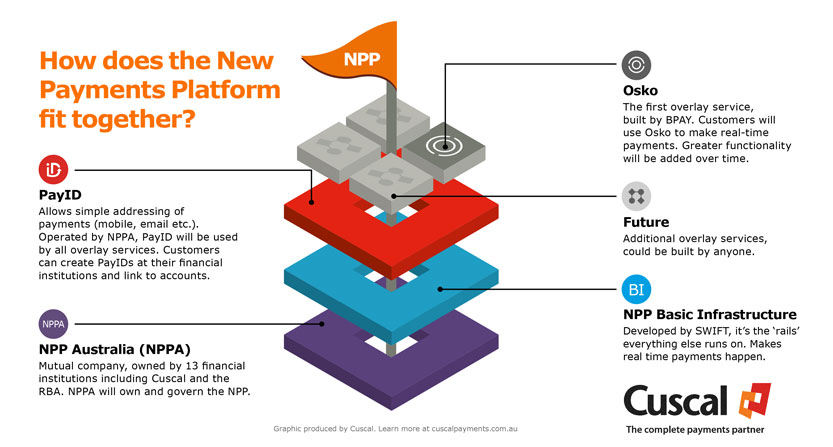
Real-time payments just got a whole lot realer with the two public-facing brands of the New Payments Platform announced today. Adrian Lovney, CEO of NPP Australia Limited, revealed in a recent interview that the first thing consumers are likely to notice when the service goes live is their bank inviting them to register for a PayID. The other new financial brand consumers can expect to see from October is Osko. With this combined public release of the Osko and PayID brands, financial institutions participating in the New Payments Platform can begin to think of the ways Australian consumers will soon interact with these affiliated brands via their personal banking experience.

The announcement of Osko and PayID raises a number of questions important to both the industry and, in time, the end user. In particular, I was curious to know how PayID and Osko relate to one another and, perhaps more importantly, why do we need both brands in the first place?

NPP infographic explaining PayID and Osko

Well, the industry has known for some time that BPAY’s overlay service was chosen as the first to be used in the New Payments Platform. It was identified as the initial way to showcase the New Payments Platform’s capabilities in as early as October 2015. The service’s brand promise has been well articulated from the outset: to provide businesses and consumers with an immediate, versatile and data-rich service to complete their everyday payments. The difference now is we know its public name: Osko.

How then does PayID fit within this scheme – how does it feature and what does it do that Osko cannot? Put simply, PayID is the brand name of the centralised addressing service that will enable direct funds transfer in an unprecedentedly personal and convenient, yet secure way. But this still leaves some wondering, how will it all work? PayID will work by linking financial accounts with recognisable and memorable pieces of information such as your phone number or email address. This will eliminate the need to select or re-enter bank account numbers without putting the security of your banking details and other information at risk.

Where then does PayID sit within the brand hierarchy of the New Payments Platform? There’s an easy way to conceive this, which is that PayID is the brand for the addressing service that can and will be used to power Osko (and other overlay services down the track too). In other words, PayID will store smart addresses for payments but Osko is the hero brand, for the first overlay service anyway, which everyone is going to use to make real-time P2P payments conveniently and securely.

It’s early days yet but I wonder what can be made of the two brand names. In particular, the first time I heard Osko, it struck me as slightly unusual. Then I considered the names of other leading brands and how they were first received when they launched in the market. Google and Uber, for example, are two brands that have achieved universal resonance, yet they probably didn’t mean anything to you at first. They certainly didn’t for me. Now, however, we find that in our thirst for knowledge in a digital age, we no longer search for something – instead, we Google it. Equally, rather than riding in a hired vehicle to get us from A to B, we simply Uber it.

While my predictive powers are not strong enough to pinpoint the ways (or precisely when) Australian consumers will begin to use Osko and PayID synonymously with making an instant payment, I think we’ve lived through enough examples which show how this might happen. When BPAY developed the Osko brand in conjunction with brand and marketing specialists, feedback from the test groups was very positive. In the time that I have used the new name in conversation, which has been for a little while now, it has really grown on me. It seems to be hitting the mark with others too.

What will really work in Osko’s favour is the open invitation it has created for BPAY and financial institutions to collaboratively shape its meaning. This reflects BPAY’s intention for Osko to be a blank canvas that allows industry participants to co-create the meaning of the new brand in the lead up to its launch.

I expect that this approach to building its brand identity will increase buzz and drive discussion around the new value it creates for Australian consumers. When I consider the New Payments Platform in its broadest context, I am mindful that up until now it has often been talked about in terms which highlight the revolutionary nature of its service.

While this is not misleading, there is another, simpler lens through which we can understand the New Payments Platform and its two public brands now that they have been released, which is that they will collectively close a current gap in the Australian payments ecosystem – the gap being our lack of a simple, convenient service available 24/7 for individuals and businesses to request and receive payments without having to disclose their personal banking details.

By Nathan Churchward, Senior Manager, Payments  

Wirecard to launch in Australia with Cuscal

A man online shopping

Sydney, 20 December, 2016: Today Wirecard AG and Cuscal announced they will be working together to allow Wirecard’s proprietary omni-channel payment processing platform to receive credit and debit card transactions in Australia.

Wirecard is a global technology group that supports companies to accept electronic payments from all sales channels. The partnership with Cuscal will allow it to offer Australian merchants its efficient method of online payment processing. Wirecard’s solution can be adapted to meet the individual requirements of each merchant, improving conversion rates at the point of check out.

Grigoriy Kuznetsov, Executive Vice President Global Financial Services at Wirecard, said:

We are delighted to expand our cooperation with Cuscal. This enables us to extend our global merchant acquiring solutions to one of the most important payment markets in the world and ensure that our customers can enjoy consistent service and seamless access to payment options worldwide.

Acting General Manager, Product & Service at Cuscal, Colin Sultana said:

We’re really pleased to be supporting Wirecard in Australia. We’re all about using our expertise and scale to help existing companies grow as well as to support new companies to enter the market. By working with companies like Wirecard we’re driving competition in payments, increasing innovation and giving businesses greater choice which will ultimately benefit everyone.

Wirecard is one of many new companies moving into the Australian payments acceptance market, creating further disruption in the payments industry overall. Most are being drawn here by the allure of large and steady revenue streams and a population ready and willing to embrace new payment technology.

Media contact
Jake Waddell jwaddell@cuscal.com.au 0417 312 902

New mobile banking app just what customers ordered

Man holding phone with a sunset in the background

Cuscal has delivered its latest white-label mobile banking app for Android and iPhone devices which offers a simple, seamless and secure user experience.

The app’s new functionality includes the ability for users to block and unblock their card as well as enables fingerprint login for Android device users. The blocking feature allows users who misplace their card to temporarily block it via the app and then unblock it once they find it. The newly added biometric functionality allows Android users to verify their identity with a fingerprint and log-in to the app, in the same way as iPhone users already can.

New, streamlined in-app navigation allows users to pay a bill or transfer money directly from their accounts in app. Additionally, to help users familiarise themselves with the new features and make the most of its capabilities, the app comes with a built-in onboarding tour.

Cuscal’s Acting General Manager, Product & Service, Colin Sultana said:
“At Cuscal we’re all about making payments as simple as possible, so with this latest mobile banking app release we’ve made our app even easier to use, and more useful.

We regularly collaborate with our clients on developing our apps, to make sure we’re including features their customers really want, and we’ve incorporated their feedback in this latest release. The added biometrics and card blocking functionality puts control back with the user and the simplified navigation gives them greater flexibility around how they make payments. So far our app has been taken up by 13 Australian financial institutions and we have another nine who are going live in the coming months which is testament to quality of the app.”

The next release is expected in February 2017.

To find out more about our mobile banking app contact your account manager, or get in touch with Cuscal CallDirect via email calldirect@cuscal.com.au or phone 1300 650 501.