
Skip to Content

Effortless Financial Assessments: Explore Basiq’s Bank Statements

basiq-insights-bank-statements

In today’s fast-paced financial world, lenders and brokers face the constant challenge of providing quick and accurate financial assessments to banks to process loans. Although core lending decisions often rely on comprehensive Consumer Affordability Reports, banks still require a traditional bank statement as part of the supporting documentation. Basiq’s new Bank Statements product is a tool that complements our existing insights affordability solution, offering a streamlined way for financial assessments to be shared with banks.

Traditionally, obtaining these statements involves a cumbersome, manual process that can delay decision-making and frustrate both lenders and customers alike. This need for speed and precision in financial assessments highlights a critical gap in the current tools available to lenders.

Understanding the pain points

  • Inefficiency: Traditional processes for retrieving and verifying bank statements are notoriously slow and can lead to significant delays in loan approval.
  • Lack of standardisation: Each bank may have different formats and data availability, complicating the assessment process for lenders who deal with multiple banks.
  • Compliance and accuracy concerns: Ensuring that the bank statements are compliant with regulatory requirements and accurately reflect the customer’s financial status is paramount, yet challenging due to varying data quality.

Bank Statements; a Basiq Insights solution

To address these industry-wide challenges, Basiq’s Bank Statements innovate on how financial assessments are conducted and shared with banks. Bank Statements compliments our existing Insights Affordability solution, providing a seamless and efficient method for generating accurate, compliant bank statements for lenders.

Key Features of Basiq’s Bank Statements

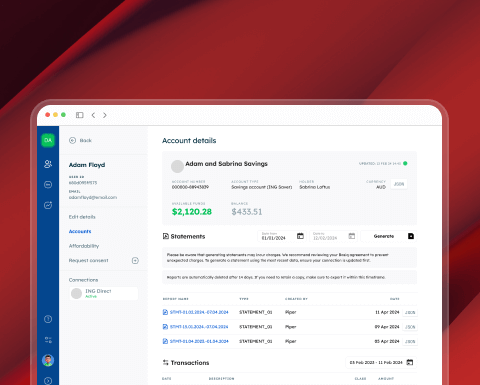
  • Access via API or our no code dashboard: Basiq’s Bank Statements can be generated through two convenient methods: via our robust API for seamless integration into existing systems, or through our intuitive no-code dashboard, which allows partners to generate and download statements in a PDF or JSON format without any technical expertise.
  • Single account focus: Tailors statements for individual or joint accounts while presenting details clearly and compliantly.
  • Custom date ranges: Enables customisation of the statement period by allowing users to easily select how far back they want to go, with the ‘To Date’ automatically set to the date the account was last refreshed to ensure the data is timely and relevant.
  • Logical running balances: Calculates logical running balances based on the transaction order, providing a comprehensive financial overview even when CDR data lacks a running balance.
  • Accreditation and Branding: Includes the logo and accreditation details of the institution, enhancing trust and credibility in the statements provided.

Basiq’s Bank Statements is an exciting step in the journey towards making financial processes more efficient and less burdensome for lenders. By addressing the key pain points in traditional bank statement processes, it enhances both the speed and quality of financial assessments, empowering our customers to make faster and more informed lending decisions.

Developer Resources

Explore our Basiq developer resources to understand more how you can integrate bank statements into your solution.

Business Consumer Disclosure Consent via Basiq’s Consent UI

business-consumer-disclosure-consent

The Consumer Data Right (CDR) in Australia has recently undergone significant updates, especially with the introduction of Business Consumer Disclosure Consent. This new form of consent broadens the horizon for business consumers, allowing them to share their CDR data with a wider array of service providers, beyond the traditional “Trusted Adviser” list. This list initially included professionals such as accountants and lawyers but now extends to include service providers like bookkeepers, finance brokers, insurance brokers, and business coaches.

If you want to know more about the changes read CDR is expanding to include non-bank lenders.

Getting straight to the point, the new CDR updates include:

  • Introduction of Business Consumer Disclosure Consent: Expands data sharing options for business consumers, facilitating sharing with a broader range of third party service providers.
  • Greater Flexibility with CDR Data: The V5 Rules update permits data sharing with software applications used for financial administration, offering substantial benefits for service providers and small businesses.
  • Encouraging Open Banking Adoption: Tailored for “business consumers,” this update opens up new opportunities for sharing financial data, crucial for accessing various funding options.

So what are the benefits for service providers?

  • Expanding Data Sharing Capabilities with less legal requirements: Service providers are able to access valuable CDR data and use it based on their existing business agreements without being bound by CDR rules.
  • Streamlining Financial Operations: With access to a broader range of applications for financial administration, businesses can streamline operations such as payroll, invoicing, and more.
  • Facilitating Access to Funding: The ability to share bank statements with finance brokers more efficiently opens up a plethora of funding options for businesses.

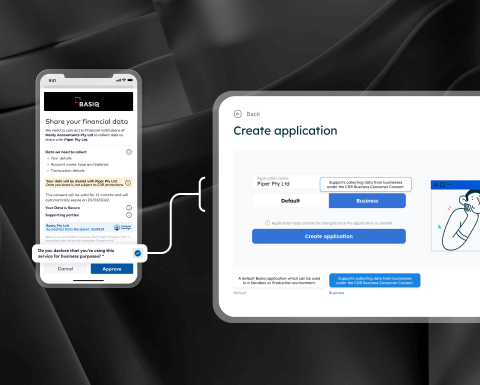
The recent updates to the CDR, present a new opportunity for businesses to engage in data sharing. Basiq’s consent UI has been enhanced to accommodate these changes, ensuring that businesses can leverage our platform to share financial data with a broader array of service providers. This enhancement is integrated into our existing consent UI, ensuring that the user experience remains consistent and intuitive.

So let’s take a closer look
The service provider Piper is wanting to collect business account details from a customer so they can offer a better service for their customer. They have integrated with Basiq to use their consent UI solution to allow their business customers to securely connect and share their bank account details in order to speed up this process and reduce manual processing. 

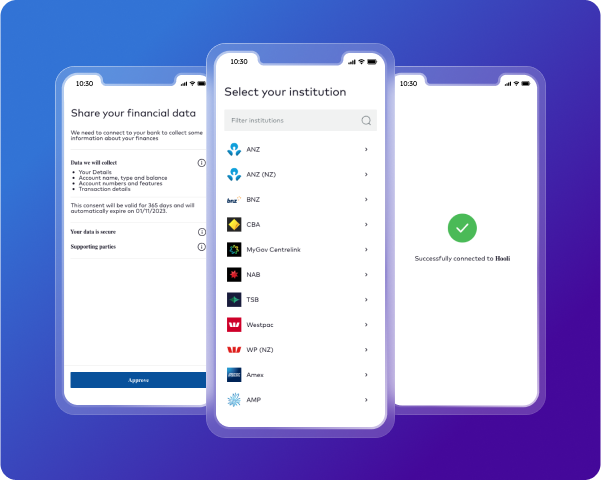
  1. The customer is met with a pre-consent screen within the piper application.
  2. When they agree to continue they are taken to Basiq’s consent UI flow to facilitate the secure access to account details through a relevant financial institution.
  3. The user is presented with details on; who has requested them to share the data (piper) and who is securely collecting it on Piper’s behalf (the ADR – Basiq), what details are being collected, for what purpose and for how long this consent will be valid for.

The Basiq consent UI simplifies the complex and verbose consent flow established by the ACCC and DSB CX (Customer Experience) guidelines. Our focus has always been to strike the perfect balance between compliance with the Consumer Data Right (CDR) regulations and offering an intuitive, user-friendly experience that maximises conversion rates. It aims to:

  • Reduce Drop-offs: By simplifying the consent flow, we aim to decrease the likelihood of users abandoning the process.
  • Increase Transparency: Users are well-informed about the specifics of the data sharing agreement, fostering trust and confidence in the process.
  • Maximise Engagement: A streamlined and user-friendly consent process encourages higher engagement rates, benefiting all parties involved.

The updates to Australia’s Consumer Data Right (CDR), featuring Business Consumer Disclosure Consent, significantly broaden the scope for financial data sharing, enhancing operational efficiency and financial management for businesses. The integration of these updates into the Basiq consent UI simplifies the data consent process, ensuring compliance while optimising user engagement. It enables service providers to offer more tailored solutions, streamlining operations and reinforcing trust in data sharing. 

As open banking evolves, Basiq continues to innovate, empowering clients and their customers to maximise the value of their financial data.

Resources
Have a read of our developer documentation to understand how you can get started with BCDC.

Harnessing Open Banking to Fight Superannuation Fraud

harnessing-open-banking-to-fight-superannuation-fraud

The closure of more than 1.4 million superannuation accounts in 20231, accompanied by disbursements exceeding $58 billion1, creates ample opportunities for exploitation by fraudsters. Manual methods employed for verifying bank account information are not only time-consuming but also prone to errors, providing openings for fraudsters to gain access to these substantial funds. 

Unauthorised access to Superanuation funds

Incidents of identity theft further contribute to fraudulent activities, enabling unauthorised access to superannuation accounts. The prevalence of data breaches over the last few years, leading to the exposure of personal and financial data, offers fraudsters the necessary information for the manipulation or misuse of superannuation accounts. 

Armed with this stolen identity data, perpetrators are able to assume the identity of their victims, navigating past security protocols to gain unauthorised access to superannuation accounts. Once inside, they are able to execute unauthorised withdrawals of substantial sums of funds. 

As criminals evolve in their strategies, the urgency to fortify the security measures within the superannuation sector becomes increasingly apparent.

The use of Open Banking

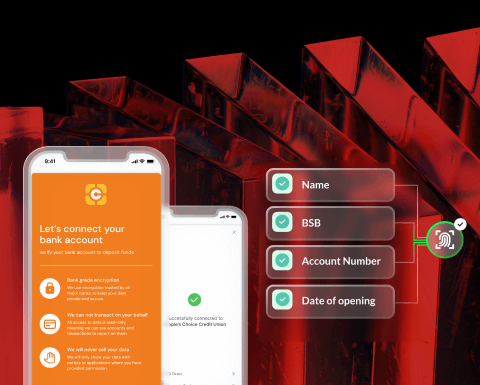
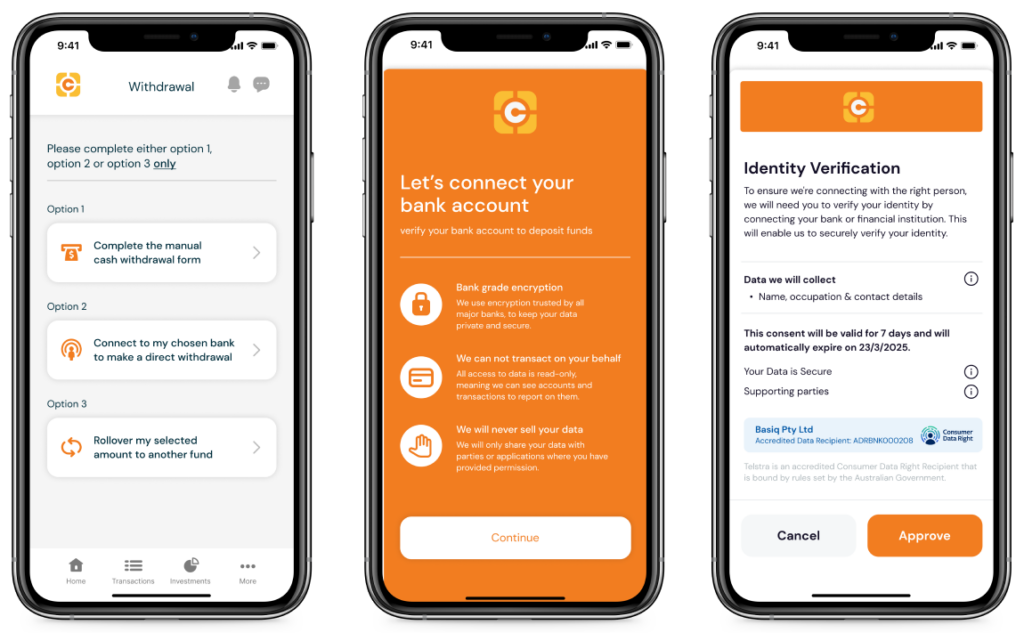
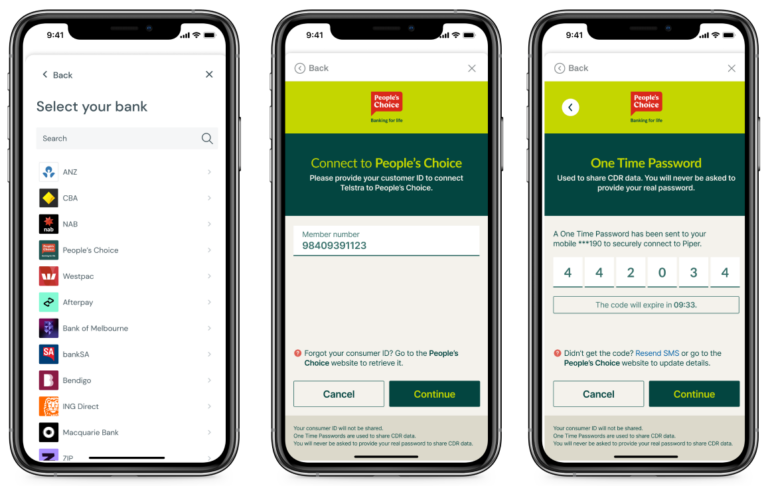
Connect by Basiq offers a comprehensive solution to fight fraud through real-time bank account verification, ensuring that superannuation withdrawals are seamlessly transferred to the intended recipients. Basiq streamlines the account verification process through secure Open Banking authentication, eliminating the need for consumers to disclose sensitive login/password information. Members initiating fund withdrawals online are simply redirected to the website/app of their nominated bank account, creating a secure and user-friendly experience while eliminating traditional steps of asking for bank account details.

TelstraSuper has embraced Open Banking to mitigate the risk of fraud. By leveraging Open Banking, TelstraSuper validates member bank account information swiftly and securely, facilitating faster transactions without the need for cumbersome hard-copy documentation.

How does it work?

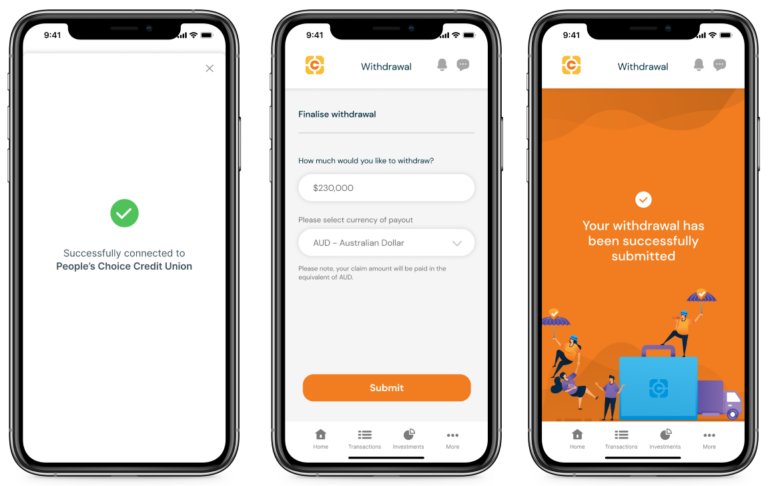
Step 1 – Member opts to transfer funds into their bank account

Step 2 – Member verifies by logging into their bank account

Step 3 – Once their bank account is successfully verified and connected, the amount to be withdrawn can be processed

Other benefits of Open Banking for Superannuation

Connecting a user’s bank account extends beyond verifying the account for transferring Superannuation funds. Financial data retrieved through the member’s various financial institutions helps create a comprehensive financial picture. Such insights enable financial advisors to provide more accurate and tailored advice, enhancing the overall financial guidance provided to superannuation members.

In addition, financial data can be used to help improve member engagement. By integrating a member’s financial data from different institutions with their superannuation data, a consolidated view of their net wealth can be created. This consolidated view allows for the development of user-friendly tools like dashboards and real-time alerts, helping members stay up to date and engaged with their financial journey and goals.

Back to Basics: What is Data Enrichment?

back-to-basics-what-is-data-enrichment

Looking at your banking app, what was the last purchase you made? Depending on your bank, you might see the:

  • merchant name (maybe even their logo?) 
  • amount spent 
  • time of purchase
  • geographic location 

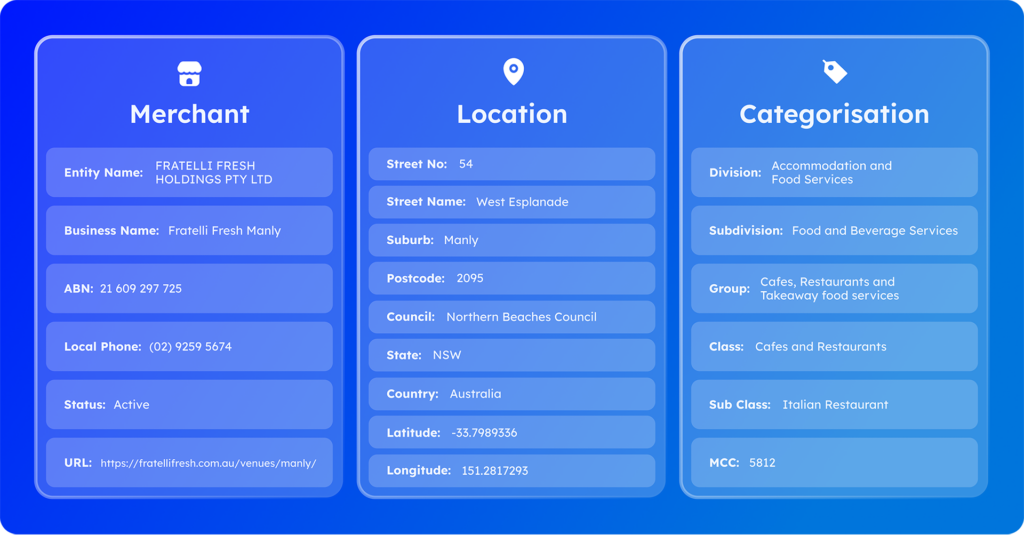
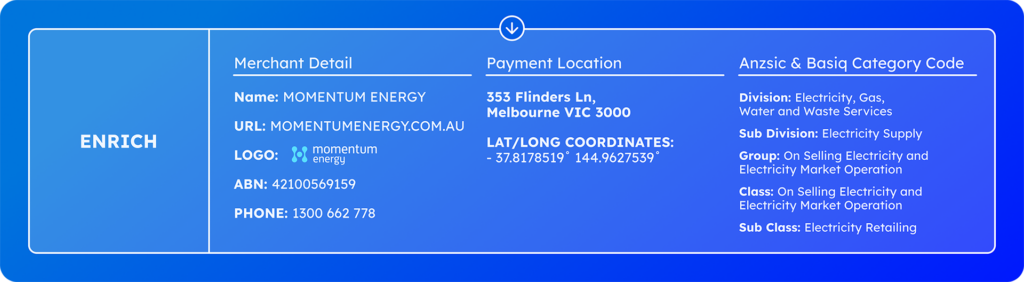
What you don’t see is the refinement process the transaction data goes through before it’s displayed. This is called data enrichment. It takes the messy raw transaction data and turns it into clean descriptions by adding the merchant’s identity, location and categorisation details (as seen below). 

Let’s go behind the scenes and explore how we turn data into insights using Basiq Enrich

The data enrichment process

Enriching banking data via the Basiq platform is a four-step process: 

  1. Data access
  2. Data tagging, cleaning and tokenisation
  3. Data enrichment
  4. Machine Learning and final output

Let’s go over each in more detail. 

Step 1: Data access 

The first step is accessing a customer’s transaction data. To do this, customers consent to securely link their bank accounts using Basiq Connect

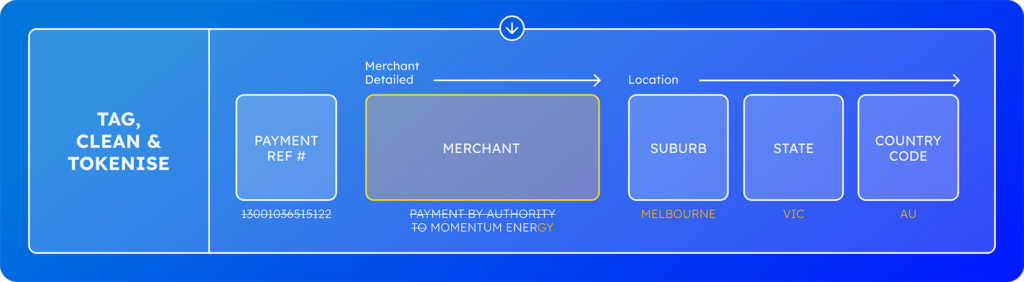
Step 2: Tag, clean and tokenise

Once the raw banking data is collected from a user’s account, transactions are separated into debits or credits

Debit

  • Bank fee: A fee incurred by the user from their bank e.g. ATM withdrawal fee
  • Payment: Payment made to a merchant 
  • Cash withdrawal: Funds withdrawn via an ATM
  • Transfer:  Funds transferred to an account 
  • Loan interest: Interest charged on a loan account 

Credit

  • Refund: Funds returned to account due to refund
  • Interest: Interest earned
  • Transfer: Funds received from an account 
  • Loan repayment: Loan repayment credited to a loan account 

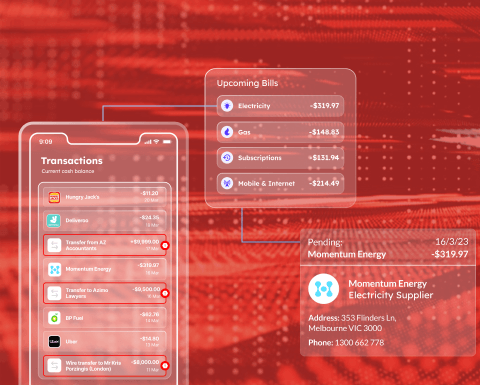
Once transactions are identified, the Basiq platform uses the transaction metadata to clean and standardise the data ready for enrichment. Below is an example of this process using a purchase from energy provider, Momentum Energy.

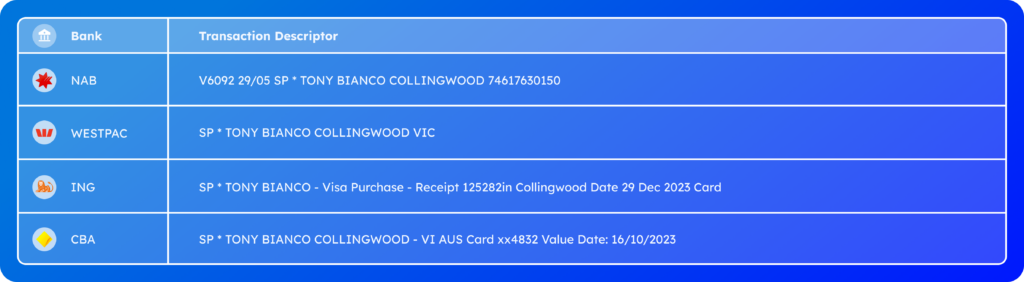
Unfortunately, there is no consistent format for transaction data across banks, so standardisation is a crucial step. For example, the image below illustrates how a transaction with footwear retailer, Tony Bianco, is returned from four different banks. To meet this challenge Basiq maintains a database of transaction description patterns by bank so enrichment can be customised depending on the institution. 

Step 3: Data enrichment  

Once tagged, cleaned and tokenised, the Basiq platform enriches the payment data by searching for a match in our curated merchant database which includes the identity, location and categorisation details.

When it comes to categorisation, we provide five levels of categorisation enabling greater granularity and richer insights. This includes four levels of ANZSIC categorisation (‘Division’, ‘Sub Division’, ‘Group’ and ‘Class’) and an additional ‘Sub Class’ using Basiq’s unique categorisation database.

Step 4: Machine Learning and final output

In our enrichment process, when a transaction cannot be initially categorised and enriched, our advanced machine learning model intervenes. This model leverages additional data sources, meticulously analysing transactions to fill any gaps that might remain after the initial steps.

Our goal with this approach is to ensure near-perfect accuracy in the data output. What sets it apart is its dynamic learning capability. With each transaction it processes, the ML model evolves improving its efficiency and accuracy. 
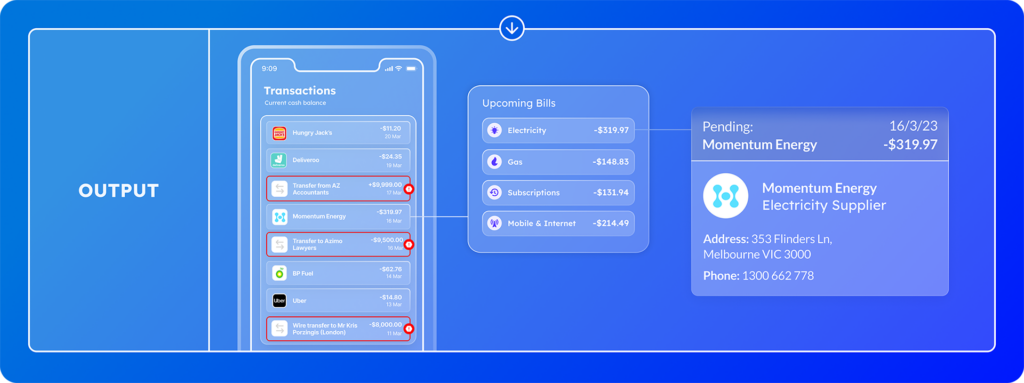
After the data has been enriched the process is complete and it’s ready for output – like your banking app. 

Basiq Enrich transforms transaction data from banking apps into clear insights.
How? By securely accessing transaction data (with permission) and applying magic—tagging, cleaning, and enrichment across each transaction using our vast merchant database and advanced machine learning.

Our goal? To make your financial data easy to understand and insightful. With Basiq Enrich, you don’t just see numbers and codes; you see your spending story unfold. It’s all about clarity, insight, and helping you make sense of where your money goes, making your banking experience not just informative but genuinely enlightening.

Want to know more?

Check out how Basiq customers are using Enrich; PokitPal and TaxTank.

Cuscal announces changes to Executive Leadership Team

Sydney, 16 February 2024

Cuscal Limited (Cuscal) confirms that after ten years with the business, Bianca Bates has resigned from her role as the Deputy CEO at Cuscal to take on a new position at Smartgroup Corporation Limited (ASX: SIQ).

Bianca held many positions within Cuscal over her tenure and led Cuscal’s operating model’s transformation, client base diversification, and successful investment in new technology and products.

Craig Kennedy, Managing Director at Cuscal, said:

In the past ten years, Bianca has played a significant role in our growth trajectory. We thank her for her outstanding contribution to Cuscal and wish her the very best in the next chapter of her career.

Bianca will remain in her current role as Deputy CEO for Cuscal until the end of the financial year. She will be integral in recruiting a new Chief Client Officer, which will commence immediately.

Cuscal also announced that Angela Powell has commenced as Cuscal’s new Chief Risk Officer, bringing over 20 years of experience in banking and financial services both domestically and internationally and expertise in risk management, governance, regulation, operational excellence, and strategic transformation.

CDR is Expanding to Include Non-bank Lenders. What Does it All Mean?

cdr-is-expanding-to-include-non-bank-lenders-what-does-it-all-mean

This year, Australia’s Consumer Data Right (CDR) is expanding to include the non-bank lending sector. Specific Non-bank Lenders will be designated as ‘Data Holders’ within the CDR framework, requiring them to implement systems to facilitate consumers in being able to transfer their data to accredited third parties.    

This builds upon the designations in the Banking and Energy sectors, where Data Holders are already operational, allowing consumers to effectively transfer their data. 

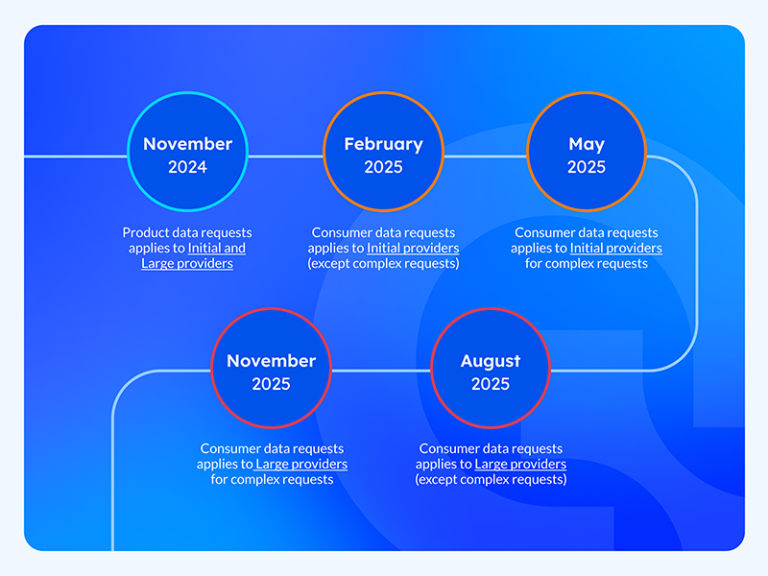
November 2024 marks the first milestone for Non-bank Lenders. So what do Non-Bank Lenders need to be aware of? 

Quick recap

The Consumer Data Right (CDR) is an economy wide designed to empower consumers with greater control over their data. It facilitates the secure sharing of data, currently housed in various organisations, with third parties in taking up new services. Banking was the first implementation of the CDR, commonly known as Open Banking, allowing consumers to consent to sharing their banking data with accredited third parties. For more detailed information on Open Banking, refer to Basiq’s definitive guide.

Following Banking, the Energy sector adopted the CDR and soon, Non-bank Lenders will join this initiative. Presently there are over 90 Banks and Energy providers acting as data holders. To see the complete list

Which Non-Bank Lenders must serve as Data Holders?

Treasury has delineated two categories of providers:

Initial provider: A non-bank lender that on the commencement date has over $10 billion in loans/leases and has averaged over $10 billion for the preceding 11 months.

Large provider: A non-bank lender that on the commencement date has over $500 million but less than $10 billion in loans/leases, averaged over $500 million for the preceding 11 months, has more than 500 customers.

What types of Non-Bank Lenders does it apply to?

Some examples of organisations it applies to include:

  • Mortgage lenders
  • Consumer finance companies
  • Buy Now Pay Later (BNPL) providers
  • Leasing and hire purchase providers
  • Marketplace lenders
  • Payday lender
  • Peer-to-peer lenders
  • Salary advance providers

What are Data Holders required to do?

Data Holders must be authorised by the ACCC, fulfilling specific criteria for data security, privacy, and technical capabilities. The implementation of robust security measures, such as encryption and access controls is required to safeguard data. Privacy compliance is crucial, ensuring data use aligns with relevant privacy laws.

Data Holders are obligated to adopt technical standards to facilitate seamless data sharing across  entities within the CDR ecosystem. This involves establishing a consent management framework to obtain and manage consent from consumers. 

Furthermore, ongoing regulatory oversight requires Data Holders to submit regular compliance reports to the ACCC and promptly address any inquiries and issues that may arise.

What are the key dates?

What is a complex request?
A “complex request” under the draft rules is a consumer data request that:

  • Is made on behalf of a secondary user of the consumer
  • Relates to a joint account or a partnership account
  • Is made on behalf of a non-individual CDR consumer whose authorisations are handled by a nominated representative

I’ll be required to be a Data Holder, what should I do?

While providing access to consumer and product data via APIs seem straightforward, the process of becoming a Data Holder is a complex undertaking. Beyond initial requirements, there are continuous obligations related to regulatory changes, maintenance and reporting. Based on feedback from existing Data Holders in the banking sector, it’s prudent to consider engaging a Partner with the requisite  expertise, experience and knowledge.  

Given the urgency and complex requirements, Non-bank Lenders falling under the scope of becoming a Data Holder should take proactive steps in initiating their CDR implementation projects. Here are our recommended actions. 

Step 1: Requirements and Timing
Familiarise yourself with what’s required and “go-live” deadlines

Step 2: Engage a Partner
Work with a Partner that can help you navigate the complex build and maintenance requirements

Step 3: API development
Start building the internal API layer to surface Users, Accounts, Transactions – needs to be done regardless of whether you engage a Partner or not. 

Changing perspectives

An inside look at Open Banking performance and adoption in Australia.

Consumer Data Right

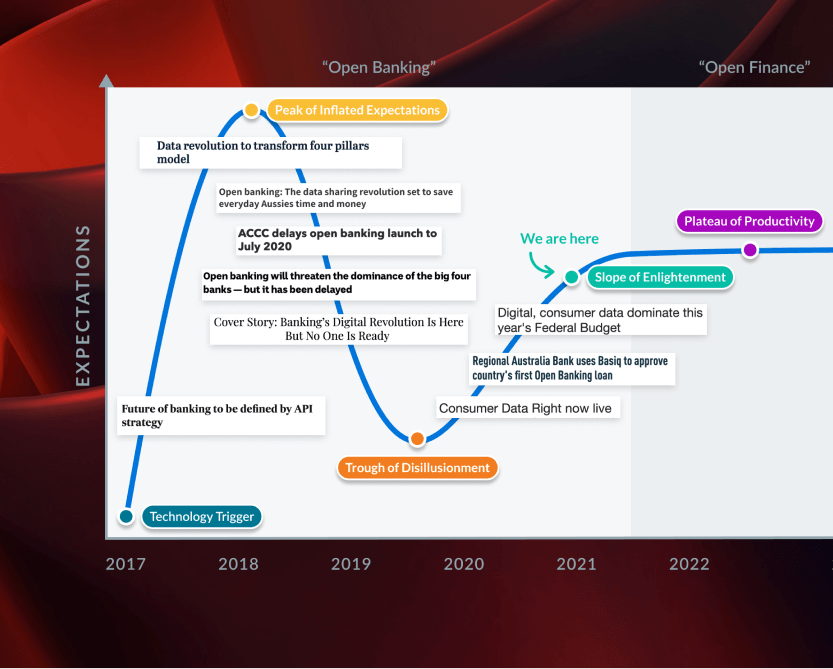
There is a lot of talk about how the Consumer Data Right (CDR) and Open Banking are performing and the majority of commentary is negative. We have found this public perception of Open Banking doesn’t align with our experience or the experience of our customers.

Basiq is one of the few data aggregators that offer both Open Banking and web scraping services. With a substantial user base across various use cases, Basiq can effectively measure the performance of Open Banking against the performance of web scraping. For the first time, we are sharing data from the Basiq platform to provide a different side of the story.

1. Open Banking has a higher growth rate than web scraping

  • Compounded monthly growth rate of Open Banking connections – 30%
  • Compounded monthly growth rate of web scraping connections – 4%

How?
Data from the Basiq platform shows that Open Banking is increasingly the preferred option for data access, with its growth rate now surpassing that of web scraping. Over an 18-month period, Open Banking connections surged from 10,400 in October 2022 to 777,000 in March 2024, resulting in a compounded monthly growth rate of 30 per cent. In contrast, web scraping connectors grew by only 4 per cent during the same period.

Why?
So, what’s the reason for the observed heightened growth? We attribute it to four key factors:

  1. The Government’s introduction of new CDR access models has reduced barriers to access for businesses
  2. An increase in the rate of significant data breaches among large corporate organisations
  3. Open Banking is a viable option for businesses previously unable to use web scraping
  4. Basiq enables customers to trial Open Banking before committing

2. Open Banking has a significantly higher connection success rate

  • Open Banking 80% Success rate – Failed connections are a result of invalid usernames/passwords, poor banking consent flow, CDR outages and potential fraudulent activities
  • Web Scraping 42% Success rate – The majority of failed connections are a result of invalid usernames/passwords

How?
It’s a common assumption that businesses lose more customers and, therefore, revenue using Open Banking over alternatives like web scraping when connecting customer bank accounts. The logic is that the friction caused by the length of the CDR data connection process results in consumers becoming frustrated and abandoning their attempt to connect their account/s.

Data from the Basiq platform shows the opposite is true. When comparing the success rate of connecting a customer’s bank account, Open Banking has a 80 per cent success rate versus 42 per cent for web scraping.

In essence, our data shows that businesses using Open Banking end up with more customers.

Why?
There are a number of events impacting the higher success rate of Open Banking versus screen scraping on the Basiq platform. These include:

  1. Consumer enters an invalid banking username or password
  2. Consumers don’t want to share their login or password details with a third-party
  3. Bank implements anti-scraping measures
  4. Planned maintenance of banking apps and online banking platforms

3. Open Banking is by far the more reliable option for ongoing connections

  • Failed connections after a 6 month period – 15% Web Scraping and 0.17% Open Banking

How?
For businesses requiring an ongoing connection to a consumer’s account, such as budgeting or investment apps, data from the Basiq platform shows that Open Banking is highly reliable.

Connection disruption can be a major issue for businesses, increasing the risk of customer churn. Consumers must complete the connection process again to establish a new connection.

Connection data across all customers on the Basiq platform indicates that 15 per cent of all consumers using web scraping will experience a disruption to their connection after six months On the other hand, connection rates using Open Banking remain consistent with less than 0.17 per cent likelihood of disruption.

Why?
Connection issues happen for a number of reasons including:

Web Scraping

  1. Consumer login details change
  2. Banks changing their UI or API
  3. Banks introducing anti-scraping measures

Open Banking

  1. Consumer revokes consent
  2. Consumer closes the connected account

Write access and the future of third party payment initiation

Basiq and Ernst and Young Australia have teamed up to write a comprehensive white paper looking at the future of Write Access in Australia.

It compares and contrasts two implementations of Write Access for third party payment initiation, proving that the Consumer Data Right is a world leading piece of legislation, drawing upon lessons from the UK and EU.

What are some of the key takeaways from the White Paper?

  • Payment initiation – The most common form of payment initiation is direct debit but this doesn’t leverage data to ensure payment success. Two new approaches have emerged to solve for this with the NPP & CDR Action Initiation.
  • Evolution of Open Banking – Open Banking enables consumers to freely share their consented financial data with trusted third parties. The CDR is currently predicated on ‘read access’ only.
  • Benefits of smart payments – The use of data in executing payments eliminates many issues currently faced with direct debits. These include the elimination of dishonour fees, avoiding failed payments and reducing the incidence of fraud.

Four new use cases for Open Banking’s future

The Australian Consumer Data Right (CDR) is designed as an exceptionally forward-thinking policy. However we are only scraping the surface of its potential.

This white paper takes a forward looking view at the Open Banking regime’s future, cemented in four novel use cases.

What are some of the key takeaways from the White Paper?

  1. Novel use cases – New use cases will emerge at the intersection of insights and action. These include Rules and event-based payment initiation, Dynamic credit risk decisioning and Autonomous personal finance.
  2. Towards Open Banking – Historically, consumers have only had the ability to interact with their data via technology known as ‘screen scraping’ but the roll out of Open Banking has accelerated.
  3. What the future holds – Open Banking will be bedded down over the next five years. As the CDR moves into other sector such as energy and telco, innovation will accelerate at an economy wide level.

Visualising an Open Finance ecosystem

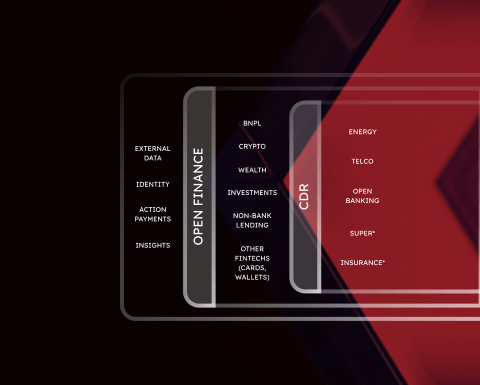
‘Open Finance’ is a term used to describe the accessibility of core financial services made available through APIs. This allows for the sharing of data across multiple financial institutions driven by consumer consent, as well as being able to do something with that data once shared, such as a payment.

The following white paper visualises what a truly Open Finance ecosystem looks like, with references drawn to Australia where necessary to add additional context.

What are some of the key takeaways from the White Paper?

  • Open Finance ecosystem model – An interconnected Open Finance ecosystem requires the core layers of Data, Insights and Actions. The proposed model outlines how the core layers interact with other inputs and outputs in the broader economy.
  • Open Finance components – There are four critical components that are required to create and enable an Open Finance ecosystem. This includes consent, data, insights and actions.
  • Benefits of Open Finance – While complex, Open Finance presents benefits to consumers including increased consumer empowerment, innovation and competition, increased financial literacy and consumer choice.