

Skip to Content

Cuscal lodges Prospectus with ASIC in relation to an Initial Public Offering and ASX Listing

Sydney, 8 November 2024

  • Cuscal is expected to list on the ASX on 25 November 2024 under the ASX ticker “CCL”.
  • Market capitalisation at Offer Price of $479m.
  • Part of the primary proceeds to be used to support Cuscal in executing its growth strategy.

Cuscal Limited (Cuscal or the Company), today lodged a Prospectus with ASIC in relation to an Initial Public Offering of 134.7m shares at a price of $2.50 per share (Offer Price). The Offer size of ~$337m comprises $40m of new capital to be raised by Cuscal, with the remaining ~$297m enabling existing shareholders to realise part of their investment in Cuscal (Shares).

The proceeds Cuscal receives from the issue of new Shares under the Offer will initially be invested in investment securities. Cuscal also expects the funds to be used to support working capital requirements; maintain a strong balance sheet and meet regulatory capital requirements; support continued investment in system resilience; and executing Cuscal’s growth strategy.

The Offer comprises:

  • The Retail Offer, consisting of the:
    • Broker Firm Offer, which is open only to Australian and New Zealand resident investors who are not Institutional Investors and who have received an invitation from their Broker to participate;
    • Employee and Director Priority Offer, which is open to Eligible Employees and Directors in Australia who may each apply for a guaranteed minimum allocation of $5,000 worth of Shares; and
  • The Institutional Offer, which consists of an invitation to bid for Shares made to Institutional Investors in Australia, New Zealand and a number of other eligible jurisdictions.

The Institutional Offer includes a cornerstone process which was commenced prior to the Prospectus Date. It is expected that certain Institutional Investors will make a commitment to acquire Shares under the Institutional Offer prior to the Institutional Offer bookbuild.

No general public offer of Shares will be made under the Offer.

The Offer is not underwritten and there will be an institutional bookbuild held on 21 November 2024 to determine final allocations of the Offer shares to raise the amount sought to be raised under the Offer.

Cuscal overview

Cuscal is an authorised deposit-taking institution (ADI), with the licences, connectivity and processing capability to support all payment types and regulated data services. The combination of these capabilities and credentials within a single organisation in Australia is limited to the four major Australian banks (Major Banks) and Cuscal.

Cuscal provides payment services to banks, financial technology companies and corporates, enabling its clients to provide payment services to their customers. As a B2B provider, Cuscal operates in the infrastructure layer of the Australian payments market, connecting clients to local payments infrastructure.

Cuscal’s business model includes the provision of three core payments capabilities including issuing, acquiring and payments. Cuscal is building capabilities in the emerging regulated data services industry and, while in its early days, it is anticipated that this may provide additional opportunities for growth as regulated data services become increasingly integrated with payments in Australia.

Operating since 1966 through its earliest predecessor, the Australian Federation of Credit Union Leagues, Cuscal has evolved from an aggregator of services for mutual ADIs to a trusted payments solutions provider.

Cuscal Chairman, Elizabeth Proust AO, said:

“Cuscal plays a crucial role in supporting connectivity to the Australian payments infrastructure for a diverse range of clients. Our unique position as an authorised deposit-taking institution, combined with our comprehensive ‘End-to-End’ capabilities in payments and regulated data services, sets us apart in the industry in Australia.

“Cuscal has been at the forefront of innovation in the payments sector, having been the first Australian company to launch connectivity solutions for Apple Pay, Google Pay and Samsung Pay. As one of 13 original shareholders of the New Payments Platform (NPP), Cuscal played a key role in the design and initial delivery of the NPP across Australia.

“Underpinning Cuscal’s strong performance is our experienced Management team, led by our Managing Director, Craig Kennedy, and a dedicated team who bring deep sector expertise across the payments landscape.

“Lodging our Prospectus ahead of an ASX listing represents a significant milestone in Cuscal’s journey, with the fundamental purpose of becoming a listed company being to give Cuscal deeper access to funding sources and provide the Management team greater flexibility to execute growth initiatives.

“On behalf of the Board, I am excited to present both current and prospective shareholders with the opportunity to invest in and contribute to Cuscal’s ongoing growth and I encourage all potential investors to read the Prospectus carefully and in its entirety.”

Cuscal Managing Director, Craig Kennedy, said:

“Cuscal powers seamless and secure connections for our clients and their customers across a range of payment types and regulated data services. We are a fully licenced authorised deposit-taking institution with a track record of successful investment that is well positioned to grow.

“Outside of the Major Banks, we are the largest centralised provider of payments infrastructure in the Australian payments industry.

“We have three key strengths – strong competitive advantages, a predictable financial model, and attractive growth fundamentals – that position Cuscal as a differentiated B2B connector to the Australian payments landscape.

“We have a long-contracted and diversified client base and we will continue to look at opportunities to expand the breadth of our payment services capabilities.

“Becoming a publicly listed company will enhance our ability to serve our clients and stakeholders. We are excited by the opportunity to welcome new investors to join us in the next chapter of the Cuscal growth story.”

Indicative IPO timetable

Prospectus Date8 November 2024
Retail Offer opens18 November 2024
Retail Offer closes20 November 2024
Institutional Offer bookbuild21 November 2024
Expected commencement of trading of Shares on ASX on a conditional and deferred settlement basis25 November 2024
Settlement26 November 2024
Issue and transfer of Shares (Completion)27 November 2024
Expected commencement of trading of Shares on ASX on a normal settlement basis27 November 2024
Expected dispatch of holding statements28 November 2024

The dates above are indicative only and may change.

BofA Securities is acting as Sole Global Coordinator, Sole Bookrunner and Joint Lead Manager. Bell Potter Securities Limited, Ord Minnett Limited and MST Financial Services Pty Ltd are acting as Joint Lead Managers to the Offer. Gilbert + Tobin is acting as Australian legal adviser to Cuscal.

For media enquiries please contact:
Peter Brookes
+61 (0)407 911 389

    – ENDS –

    IMPORTANT NOTICES
    Capitalised terms not defined in this document have the meaning given in the Prospectus.

    This document contains certain forward-looking statements and comments about future events. Forward-looking statements can generally be identified by the use of forward-looking words such as, ‘expect’, ‘anticipate’, ‘likely’, ‘intend’, ‘should’, ‘could’, ‘may’, ‘predict’, ‘plan’, ‘propose’, ‘will’, ‘believe’, ‘forecast’, ‘estimate’, ‘target’ and other similar expressions within the meaning of securities laws of applicable jurisdictions. Indications of, and guidance or outlook on, future earnings or financial position or performance are also forward-looking statements. Forward-looking statements involve inherent risks and uncertainties, both general and specific, and there is a risk that such predictions, forecasts, projections and other forward-looking statements will not be achieved. A number of important factors could cause the Company and the Group’s actual results to differ materially from the plans, objectives, expectations, estimates and intentions expressed in such forward-looking statements, and many of these factors are beyond the Company and the Group’s control. Forward-looking statements are provided as a general guide only, and should not be relied on as an indication or guarantee of future performance and involve known and unknown risks, uncertainty and other factors, many of which are outside the control of the Company and the Group. As such, undue reliance should not be placed on any forward-looking statement.

    Past performance is not necessarily a guide to future performance and no representation or warranty is made by any person as to the likelihood of achievement or reasonableness of any forward-looking statements, forecast financial information or other forecast. Nothing contained in this document nor any information made available to you is, or shall be relied upon as, a promise, representation, warranty or guarantee as to the past, present or the future performance of the Company and the Group.

    This document is not, and does not constitute, an offer to sell or the solicitation, invitation, advertisement or recommendation to purchase any securities or other financial products in any jurisdiction and neither this document nor any of the information contained herein shall form the basis of any contract or commitment. In particular, this document does not constitute an offer to sell, or a solicitation of an offer to buy, any securities in the United States.

    The information in this document remains subject to change without notice. No responsibility or liability is assumed by the Company, its related bodies corporate or any of their respective officers, employees, advisers and agents for updating any information in this document or to inform any recipient of any new or more accurate information or any errors or mis-descriptions of which any member of that group may become aware.

    Full details about the Offer are contained in the Prospectus dated 8 November 2024 issued by Cuscal Limited (ACN 087 822 455) and Cuscal SaleCo Limited (ACN 670 386 713).

    The Prospectus is available in electronic form to Australian and New Zealand residents on the Company’s offer website, https://events.miraqle.com/cuscal-ipo. The Offer constituted by the Prospectus in electronic form is available only to Australian and New Zealand residents accessing the website within Australia or New Zealand and is not available to persons in any other jurisdictions, including the United States.

    A hard copy of the Prospectus is available free of charge during the Offer period to any person in Australia by calling the Cuscal Offer Information Line on 1800 336 109 (toll free within Australia) or +61 1800 336 109 (outside Australia) between 8:30am and 5:30pm (Sydney time), Monday to Friday (excluding public holidays). Applications for Shares may only be made on the Application Form attached to, or accompanying, the Prospectus in its hard copy form, or in its soft copy form available online at https://events.miraqle.com/cuscal-ipo, together with an electronic copy of the Prospectus. By making an Application, you declare that you were given access to the Prospectus, together with an Application Form.

    The Corporations Act prohibits any person from passing the Application Form on to another person unless it is attached to, or accompanied by, the Prospectus in its paper copy form or the complete and unaltered electronic version of the Prospectus.

    Helping Families Navigate the Challenges of Youth Banking

    Learning financial skills is fundamental to leading a fulfilling life. Yet at present both young people and their parents believe that financial institutions are falling short in meeting their information, service and education needs. In this video, we dive deeper into the key themes uncovered in our latest Youth Banking White Paper and share how financial institutions are well-positioned to develop innovative, educational, and accessible banking solutions that can strategically connect with the next generation of financial customers and seize opportunities in this dynamic market.

    Inside this video:

    • Uncover the crucial stages of financial development for young Australians and the impact on your youth banking strategy — from the basics of money management to navigating digital payments and the influence of social media.
    • The three strategic decisions financial institutions must make to capture the youth banking market effectively.
    • Why a one-size-fits-all strategy fails for the 6-year-old to 22-year-old age group and the importance of adapting your products, messaging, and experience for each life stage.
    • The four main opportunity gaps between current banking offerings and the growing needs of parents and young people.
    • Understanding the ebb and flow of parent involvement along the youth banking journey and how to build this into your strategy and approach.
    • The importance of tone of voice and platform-appropriate experiences for digital-native youth.
    • The correlation between financial literacy and financial inclusion and how it affects customer lifetime value.

    Featured Speakers:

    • Sarah Rowley, Senior Product Manager for Issuing, Cuscal,
    • Dawn Mischewski, Research and Customer Insights Specialist – Phase One Insights, and
    • Ryan Yuzon, Senior Director, Visa Consulting & Analytics, Visa Australia.

    Watch this video now and learn how these insights can help you develop a program for the youth segment in line with your wider customer lifecycle strategy.

    Eye on the Future: Helping Families Navigate the Challenges of Youth Banking

    A picture of a family with parents and two children sitting in a loungeroom

    With 26% of the global population under 15 years old and projected growth of 7% by 2030, according to the United Nations World Youth Report, 2020, the landscape of youth banking is rapidly evolving, presenting both challenges and unprecedented opportunities for financial institutions. Our latest white paper shares in-depth findings of the financial learning journey at each youth life stage and delves into the strategic imperatives of targeting this 5.5 million strong demographic—from understanding their digital-first expectations to nurturing lifelong customer relationships.

    Inside, we explore crucial topics such as:

    • Evaluating the $825 billion total opportunity value of the youth segment and its strategic importance within your financial institution’s broader vision.
    • Quantifying the correlation between early financial education and sustained customer loyalty—explore strategies to capitalise on this proven link.
    • Understanding why conventional banking methods are falling short in meeting the precise financial literacy needs of today’s youth—and learning actionable solutions to address these gaps effectively.
    • Detailed insight into the youth financial learning journey and how to develop compelling youth banking propositions that drive both acquisition and retention.
    • Uncovering the five key elements of a robust youth strategy to harness competitive advantage.
    • How to navigate regulatory landscapes and forge strategic partnerships to bolster your youth banking initiatives, ensuring both compliance and market relevance.
      Ready to transform your approach to youth banking?

    How can Cuscal help your organisation?
    With nearly 60 years of expertise, Cuscal can partner with you across the whole payment ecosystem. Harnessing our deep knowledge of the Australian financial market and robust regulatory experience, we can help your organisation bring to life the digital experiences required to attract and retain these customers.

    If you would like to speak to us about your youth banking strategy, email us at getintouch@cuscal.com.au.

    Webhooks: Boosting Efficiency with Meaningful Events

    webhooks-boosting-efficiency-with-meaningful-events

    Introduction to Webhooks

    Have you ever wished your systems could talk to each other automatically without you having to constantly check for updates? That’s where webhooks come in. Webhooks are like messengers that instantly notify your system when something important happens. This way, you can automate processes and get real-time updates without any manual intervention.

    What’s new?

    We’ve recently rolled out enhancements to our webhook system to make them more efficient and valuable. 

    Hello to meaningful events

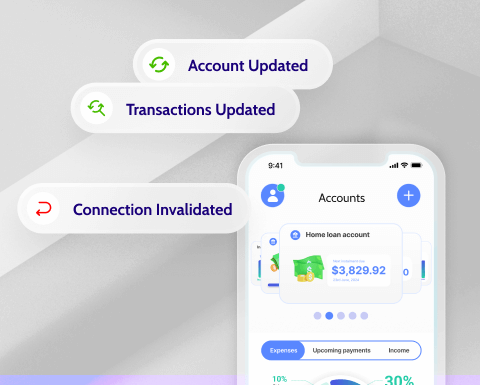
    • account.updated: This event is triggered when there are changes to an account’s details (excluding balance changes). This means you’ll get notified if any details like account name or type change, but not for balance changes.
    • transactions.updated: This event is triggered whenever new transactions are added for a user. This helps you keep track of all transaction activities without being bogged down by minor updates.
    • connection.invalidated: This event will notify you when there’s an issue refreshing data due to user-related errors like password changes or multi-factor authentication (MFA) issues. This way, you’ll know when something requires your immediate attention.

    Why the change?
    Previously, the connection.updated events were overwhelming and often required multiple API calls to find relevant information. This made the data less meaningful and actionable. Our goal with these new events is to provide updates that are directly useful and can help you make informed decisions quickly.

    A few examples of how you can use events and webhooks in your application

    Lending and Financial Decisions

    • transactions.updated: Lenders can use this webhook to get real-time updates on a borrowers’ financial activities. For instance, when a borrower’s salary is deposited, you can automatically process loan payments.
    • connection.invalidated: This webhook alerts you when there’s an issue with user authentication. For lenders, this means you can quickly address authentication problems, ensuring a smooth customer experience.

    Account Management

    • account.updated: Financial institutions can use this webhook to monitor changes in account details. For example, if a user updates their account information, you can automatically update your records, ensuring accuracy and compliance.

    Future enhancements

    We are continuously working on making our webhooks smarter and more intuitive. Stay tuned for future updates that will bring even more value to your automated processes.

    Get started with webhooks

    Are you ready to implement these enhanced webhooks in your products or applications? Don’t miss out on valuable insights and automation opportunities.  Check out our developer documentation to get started today!

    Curious Thinkers 2023- A Look Back 

    In 2023, on the 18-19 September Cuscal held its annual anticipated thought leadership event on the 18th and 19th of September 2023.

    This exclusive, invite-only, two-day conference allowed our clients to hear from both local and international experts at the Winx Stand at the Royal Randwick Racecourse. The focus was on the latest data and payment trends, including real-time payments, fraud and scams, global economic outlook, social engineering, and innovative customer solutions that are shaping the industry.

    The theme for Curious Thinkers 2023 was: REIMAGINE THE FUTURE: UNLEASH THE POWER OF DATA, DIGITAL, AND REAL-TIME TO ENHANCE CUSTOMER EXPERIENCE AND TRANSFORM YOUR BUSINESS
    A huge thank you to all of our speakers who made this Curious Thinkers 2023 a resounding success. Their insights and expertise provided invaluable knowledge and inspiration to all our clients. And thanks to Synechron for kindly sponsoring the pre-dinner drinks on Monday 18 September 2023.

    Watch the event wrap up and explore more about the agenda and speakers from Curious Thinkers 2023.

    New CDR Reforms Set to Boost Australia’s Digital Economy

    new-cdr-reforms-set-to-boost-australias-digital-economy

    In a recent speech by Assistant Treasurer Stephen Jones at a CEDA (Committee for Economic Development of Australia) conference, significant changes were announced that aim to reshape Australia’s digital economy, focusing on the Consumer data right (CDR), privacy, and cybersecurity. The speech highlighted both the benefits and challenges brought by the digitisation of the economy, emphasising the need for stronger protections and more effective use of consumer data.

    A focus on Privacy and Data protection

    The speech underscored the importance of data in the digital economy, recognising the growing concerns among Australians about privacy due to rising incidents of cybercrime and data breaches. To address these concerns, the government is reviewing the Privacy Act to ensure it is fit for the digital age. This review will impose higher standards on businesses to protect customer data.

    View the speech by Assistant Treasurer Stephen Jones.

    CDR compliance costs report

    Heidi Richards’ CDR compliance costs review report, released by Assistant Treasurer Stephen Jones, found that the costs of the Consumer Data Right (CDR) have far exceeded original estimates, with large banks facing significant burdens due to complex technical requirements. The report raises concerns about the rapid changes to CDR rules, low customer usage, and the lack of innovation, partly due to restrictions on using CDR data. Businesses haven’t been incentivised to use CDR data, which has hindered broader adoption and innovation. The report calls for clearer strategic planning and prioritisation of future changes.

    View the CDR compliance cost review paper

    Reimagining the CDR

    The speech acknowledged that the current implementation of the CDR has been flawed, with high regulatory burdens, low uptake, and limited innovation. To address these issues, the government is launching a reset of the CDR, focusing on several key areas that include:

    1. Streamlining consent processes: The government will simplify how consumers give consent to use their data, allowing for multiple consents in a single action, making it easier and more user-friendly.
    2. Improving business access: The government will mandate that data holders, such as banks, provide a straightforward process for businesses to access their own data. This will help businesses, especially small ones, to benefit from the CDR.
    3. Consumption of CDR data: New rules now allow accredited deposit-taking institutions (ADIs) who are data holders to hold consumer data under the Consumer Data Right (CDR) when a consumer applies for or acquires a product. ADIs must notify consumers that their data will be held and inform them of relevant privacy safeguards. This could help accelerate the use of CDR data by banks who are data holders. 
    4. Reforming Standards and Costs: The government will introduce a more structured approach to making standards changes. This includes limiting changes to a few scheduled releases per year, ensuring longer lead times, and considering the cost and regulatory impacts on participants.
    5. Focusing the scope of CDR: To reduce unnecessary costs, the government is examining the possibility of narrowing the scope of data included in the CDR, removing products unlikely to be used.
    6. Prioritising high-value use cases: The reset will prioritise consumer finance, energy switching, and accounting services for small businesses, where the potential benefits to consumers are highest.
    7. Sector expansion: It was confirmed that Data holders would be extended to non-bank lenders to be operational by mid 2026.

    View the Consumer Data Right Rules: consent and operational enhancement amendments consultation

    Strengthening Cybersecurity and Digital identity

    The speech also highlighted the ongoing efforts to strengthen cybersecurity through the National Cyber Security Strategy and modernise the payments system. The government is committed to ensuring that digital identity systems, which simplify and secure the verification process, will reduce the amount of data businesses and governments need to hold, further protecting consumers. There was also a commitment to align CDR development with Digital ID, Payment system reform and Privacy act reform.

    View the 2023-2030 Australian Cyber Security Strategy

    Moving away from unsafe practices

    A significant announcement was the government’s stance on screen scraping, a practice where businesses ask consumers to share their bank passwords. The government is considering a full ban on screen scraping, emphasising that it is fundamentally unsafe and that the CDR should become the system of choice for data sharing. With a commitment to phase out screen scraping, the next 12 months will see Treasury develop a full transition plan.

    View the report by Basiq comparing the performance of Open Banking and Web Scraping: “An inside look at Open Banking performance and adoption in Australia

    Action Initiation bill passes

    Since launch, the Consumer Data Right (CDR) has been “read-only,” allowing data recipients to access and use the data for purposes like lending assessments, budgeting tools, and product comparisons. However, the introduction of the new action initiation power will add a “write” capability, enabling recipients to not only view the data but also perform actions on behalf of customers, such as making a payment, switching providers and updating personal details using the CDR framework.

    Amends the Competition and Consumer Act 2010 to establish action initiation reforms, enabling consumer data right (CDR) consumers to direct accredited persons to instruct on actions on their behalf, such as making a payment, opening and closing an account, switching providers and updating personal details, using the CDR framework.

    On the same day as Assistant Treasurer Stephen Jones announced the CDR reforms, the Senate passed the CDR action initiation bill. While this is exciting news, the government will still need to consult with industry stakeholders to determine its application, and detailed rules will need to be established.

    View the Treasury Laws Amendment (Consumer Data Right) Bill 2022

    Conclusion

    The speech marked a pivotal moment in the government’s approach to the digital economy, with a clear commitment to improving the CDR, enhancing privacy protections, and fostering innovation. The reset of the CDR aims to reduce costs, encourage adoption, and ensure that consumers truly benefit from the data they generate. By focusing on these areas, the government hopes to build a digital economy that is both safe and innovative, where consumers can trust that their data is protected.

    Global Economic Outlook

    Simon Baptist, Visa Principal Economist for Asia Pacific caught up with Bronwyn Yam, Cuscal Chief Product Officer in Sydney to discuss the global economic outlook and how it may impact the Australian economy.

    They discuss:

    • the key factors that are driving the economy,
    • the themes for the year ahead,
    • shifts in trade in the Asia Pacific,
    • how the US election and tourism could impact Australia and
    • how new technology and Gen Z may affect payments in the future.

    Watch Simon Baptist share his knowledge and insights for 2024 with Bronwyn Yam.

    1.3 Million Connections by December: Insider Data Reveals Open Banking Success

    1-3-million-connections-by-december-insider-data-reveals-open-banking-success

    Basiq, a leading data aggregator, has released a new report, Changing Perspectives: An inside look at Open Banking performance and adoption in Australia, detailing critical findings on the performance and growth of Open Banking in Australia. 

    To date, Basiq has enabled over 900,000 Open Banking connections between consumers and businesses to help with tasks such as budgeting, investing, tax reconciliation and loan applications. It’s expected that by December 2024, the number of Open Banking Connections will hit 1.3 million.

    The report analyses connection data from the Basiq platform including volume, success rates and ongoing performance, benchmarking it against the performance of web scraping. Web scraping, also known as Digital Data Capture (DDC) or screen scraping, is the widely used alternative and predecessor to Open Banking.

    Analysis of the data has revealed three key findings:

    Finding 1: Open Banking growth is booming

    The popularity of Open Banking is steadily increasing, challenging the perception of slow growth and minimal uptake. Between October 2022 and March 2024, Open Banking experienced a 30 per cent compounded growth rate on the Basiq platform, with connections rising from 10,400 to 777,000. In the last 12 months, almost 50 per cent of all new connections on the Basiq platform were made via Open Banking.

    Finding 2: Open Banking leads to more customers

    Contrary to the belief that Open Banking results in high consumer drop-off, Basiq has found its success rate is almost double that of web scraping, with 80 per cent chance of success compared to 42 per cent. Financial institutions implementing more robust anti-scraping measures and heightened business and consumer concerns regarding data security are impacting connection success rates.

    Finding 3: Open Banking is superior for ongoing connections

    Only 0.17 per cent of Open Banking connections face disruption after six months, compared to 15 per cent for web scraping, making Open Banking 88 times more reliable for businesses requiring ongoing connections, such as budgeting or investment apps.

    “We wanted to release our findings publicly to challenge the existing negative Open Banking narrative and provide a more optimistic perspective backed by data,” said Damir.  

    “While Open Banking is far from perfect, the highly critical views circulating do not reflect the reality we see,” Damir continued. “Our platform data and customer feedback tell a very different story – one of growth and success.”

    “Acknowledging that connection performance is only one factor impacting Open Banking’s growth, we intend to dive into other key topics, including data quality, in future reports,” closed Damir.

    Optimising Trust Account Reconciliation Processes

    Trust accounts are a fundamental vehicle for individuals and organisations to safeguard and manage assets for designated beneficiaries. They play a vital role in protecting assets and ensuring their proper distribution, a common practice in industries such as medicine and law, as well as in charities, estate planning, and investments.

    The challenges of reconciling Trust accounts

    The reconciliation of trust accounts involves collating data from various sources including bank statements, client records, and internal systems. Consolidating and reconciling data from these disparate sources is a labour-intensive process.

    It can involve requesting and uploading bank statements and meticulously matching transactions, a tedious process that consumes valuable time and resources. As a result, it can be prone to inefficiency and errors which can jeopardise the integrity of the trust and expose it to the risk of misappropriation.

    Using Open Banking

    Open Banking provides an avenue to optimise the trust account reconciliation process by enabling access to real-time data from banks.  

    1. Save time and money
    Say goodbye to manual requests and uploads. Open Banking facilitates swift access to real-time banking data, eliminating cumbersome paperwork and expediting the reconciliation process. By automating routine tasks, financial professionals can focus on value-added activities, saving time and reducing costs.

    2. Streamlined access
    Navigate multiple consent flows with ease. Open Banking offers a unified method for accessing banking data from various accounts, simplifying workflows and enhancing convenience. With just one consent, financial professionals can access a wealth of information, making trust account management more efficient, especially when ongoing access to banking data is possible. 

    3. Easily spot irregularities
    Access to real-time banking data means the process of identifying discrepancies becomes straightforward. Whether it’s an outlier transaction or a mismatched entry, ensuring accuracy and compliance is a straightforward process.

    4. Data insights
    Access to real-time banking data through Open Banking allows for data-driven insights that can inform strategic decision-making. Financial professionals can analyse trends, identify patterns, and make informed decisions to optimise trust account management strategies.

    Accessing Open Banking with Basiq

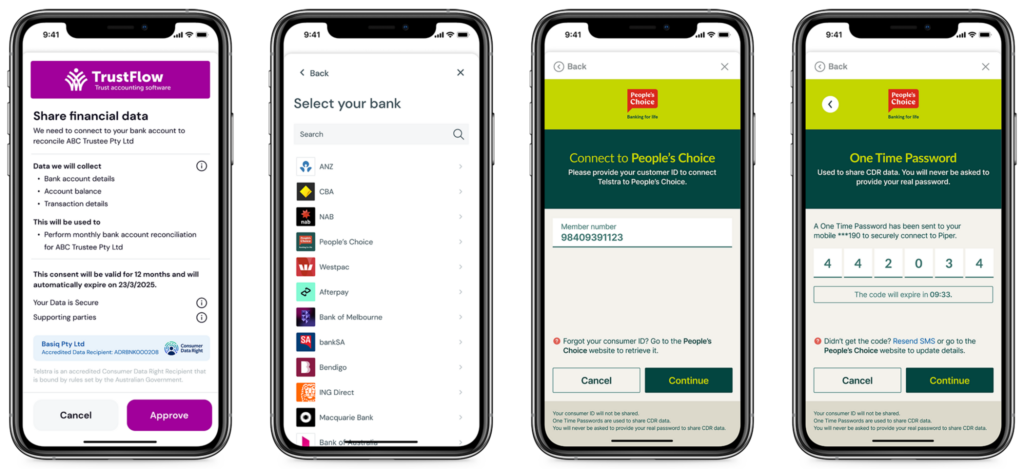
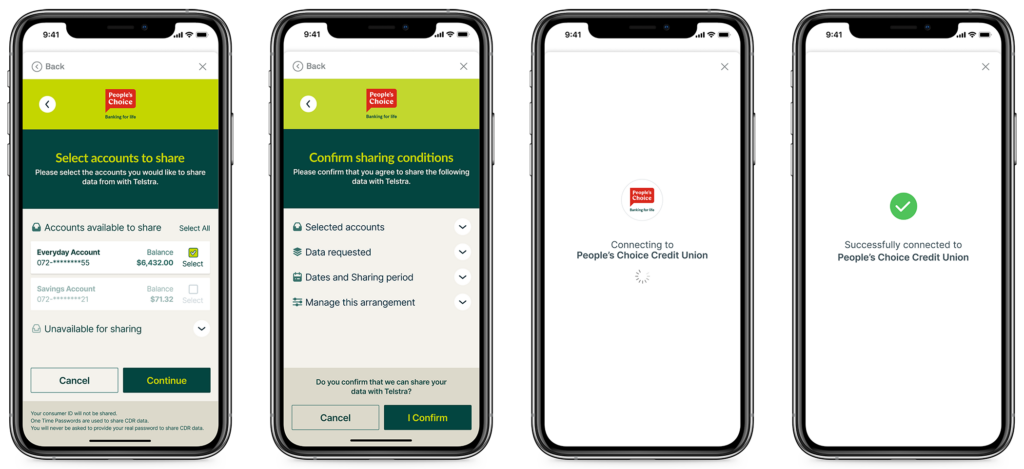
    Accessing Open Banking via the CDR is a straightforward process where the owner of the bank account consents to their data being shared. The user is redirected to their respective bank to login via their Internet banking portal.

    Once the respective bank account is selected the data can be shared with ERP systems, accounting software and specific trust accounting software to optimise the reconciliation process.

    Why the Consumer Data Right is more than a compliance cost for non-bank lenders

    Picture of Bronwyn Yam

    The past couple of years have meant significant growth for non-bank lenders and there are no signs of slowing down, says Bronwyn Yam, the chief product officer at Cuscal.

    According to the RBA, the sector grew on average 15 per cent on a six-month annualised basis, more than twice the rate recorded by banks.

    It is an exciting – and competitive – time. And it is in this context that the non-bank lender sector prepares to be the next one rolling out the Consumer Data Right (CDR) in Australia. While some organisations try to understand how to best navigate this complex initiative, a key aspect may get lost amid the regulatory language: CDR is way more than compliance costs.

    For those organisations willing to make this part of their digital transformation, the initiative presents opportunities to stay competitive, improve efficiency, enhance customer experiences, and drive innovation in the financial services sector.

    As a partner of many banking and non-banking organisations, we’ve seen firsthand how data can improve an organisation’s ability to draw strategic insights for its business plans. The good news is that some implementations can be API-driven on a subscription basis, enabling users to securely share their data and empowering companies to build improved financial applications.

    Here are key takeaways on how a well-implemented CDR solution can boost businesses.

    • Improved customer experience: As an accredited organisation, non-bank lenders will have access to use consumer data to offer more tailored solutions. Companies that channel this supercharged data pool to drive innovation and product development will deliver improved customer experiences and personalised financial services – a potential make or break in a competitive environment. Easy wins include increasing conversion rates by fast-tracking your lending application process with a mobile-first experience, expedited approval times, quick account verification and pre-funds checks, and streamlined onboarding, easing the deposit of funds and progressing the lending cycle from origination to collections. And this is just the beginning of improved customer experience.
    • Increased visibility of client movement: Non-bank lenders, as mandated data holders, should want access to the metadata generated by their existing customers sharing their data with other organisations. This new dataset becomes a source of powerful insights. At Cuscal, we call them a moat for our clients, protecting their businesses’ revenue and profit. The premise is that if companies use and analyse the data properly, they will notice trends or clients looking to move, allowing them to counteract with a better experience.
    • More accurate risk management: While accessing data is a crucial step in developing a financial application, extracting insights from it truly unlocks its value. Adding comprehensive data overlay services helps companies harness the power of data to make more informed lending decisions, improve risk control, proactively manage hardship, and reduce default rates. Benefits include a deep understanding of spending behaviour with access to enriched transaction details, empowering non-bank lenders to improve their risk assessment capabilities.
    • Increased cyber security: Maintaining robust cyber security practices helps build trust and confidence with your customers and assures them that their data is handled securely and responsibly. CDR also changes the game for consumers and businesses regarding cyber security. It is a safer solution than outdated methods, such as screen scraping, which require customers to share their login details with third parties (e.g. lenders and brokers) for the various compulsory checks for responsible lending obligations. Banning these insecure practices, such as sharing PDFs and scans of transaction statements, minimises the risks exposed by storing them.
    • Compliance with standards and regulations is a key requirement for organisations participating in the CDR framework. That means non-bank lenders will automatically adhere to industry standards and guidelines to ensure data security, limiting exposure to malicious activity.
    • Data protection measures include encryption, access controls, and secure data storage practices to safeguard sensitive information. The CDR framework also imposes ongoing monitoring and auditing of databases, securing consumer data by increasing the chances of discovering risks and losing integrity in datasets.

    In summary, CDR is more than a compliance cost to non-bank lenders. It is the next step to increase business competitiveness and protect businesses and consumers in Australia. CDR is about giving consumers peace of mind when they transfer personal data online and giving them control over their vulnerable data.

    As CDR continues to roll out, we anticipate a stronger, more protected ecosystem in which organisations, CDR solution partners, and customers are building collectively towards a safer digital economy.

    There is much to learn from other industries in preparation for the legislation. However, the reality is that non-bank lenders should consider adopting CDR solutions regardless of the government timelines. CDR will be a reality and the sooner they can be ready and start benefiting from the advantages of data and insights to protect and boost their business, the greater value they will get for their investment.

    By Bronwyn Yam, Chief Product Officer

    This article was originally published on www.mortgagebusiness.com.au on 6 May 2024.