Skip to Content

Mobile app now has biometrics and more

Lady holding moble phone using her finger print

We have recently enhanced the functionality of our white-label, full-mobile banking app to include biometrics (fingerprint login), overseas notifications and feedback form as well as enhancing some current features. The next release of extra functionality is due in April/May.

Users with an iPhone 5s and above can now sign in to the app using their fingerprint, which will be safely stored in the device. For clients which also have our Vigil Fraud Bureau Service the app will allow customers to notify us about overseas travel, ensuring their cards will continue to function normally while travelling.

Commenting on the release, Cuscal’s Head of EFT, Acquiring and Digital, Colin Sultana said:

“This latest release builds on the existing functionality, including NFC tap and pay which we were the first to introduce in the Asia-Pacific, with CUA. These latest enhancements make our mobile banking app the most advanced of any white-label solution in Australia and equal to or better than some of the big banks’ offerings.

This is a very exciting time for mobile payments in Australia with Apple Pay arriving late last year in a limited form after a deal with Amex, Android Pay launching in Australia soon and Samsung Pay likely to arrive at some point this year.”

The next release of functionality for our full mobile banking app is due in April/May 2016 and is currently scheduled to include:

  • The ability to block cards
  • New and improved look and feel to the current mobile apps

RFi interview: Ashley on mobile banking and payments

Image of Ashley Williams, Senior Digital Manager, CuscalAs we jump feet first into 2016, RFi Group had the pleasure of sitting down with Ashley Williams, Cuscal’s Senior Manager – Digital, and someone right in the Cuscal workroom, to discuss progression in the mobile banking and payments apps space and what the latest is when it comes to digital wallets.

As General Manager of Product & Service at Cuscal Adrian Lovney stated in a LinkedIn Pulse Post early this year, 2016 is set to be the year mobile wallets go mainstream in Australia.

The announcement just before Christmas that Android Pay will arrive in Australia in early 2016 is big news for payments, but it’s also another significant step that’s slowly, but inevitably, taking mobile payments from niche to mainstream. There has been a lot of chatter about mobile wallets being the future of payments in Australia, but so far we haven’t seen many people actually use their mobile phones as wallets. 2016 is looking like the year that will change this.

RFi Group met with Ashley who went on to explain Cuscal’s sharp focus on providing superlative technical integration for their customers and are currently nothing short of delighted to be experiencing such a huge take up for the new product. With 41 of their clients signing up to The Pays for day one, the figures are accounting for roughly 90% of their card volume.

Providing these solutions for our clients means that the work we do for them now, puts them in a key position to be able to launch into other wallets as soon as they’re available. We are focused on that technical build, creating and facilitating the links into the schemes (specifically Mastercard, Visa and eftpos) and then into the three different wallet providers (Google, Apple and Android) – meaning phones can in effect become a digital wallet.

As well as managing the technical integration and back end ‘maze’ of complexity this project brings, Cuscal will be providing customers with marketing toolkits and training support to guide them through the adverting process.

And to help, they have some pretty stellar partners –

We’re collaborating with Google to ensure the campaigns are consistent across the market and offer a seamless customer experience. In terms of Cuscal itself, all 41 of our clients will be out in the market promoting and marketing from day one.

With all this change, we wondered, what can customers expect? Ashley is frank but fair –

Obviously mobile banking apps with contactless payments have been around for some time, and the payments part of the equation isn’t something new, what we do believe is going to change is the market awareness and public’s perception of payments – it is really set to shift dramatically.

Ashley goes on to cite the key differences for the Android Pay launch, compared to the way Australian financial institutions launched their mobile wallets in dribs and drabs. There is a clear plan to wait until everyone is ready and “all the ducks are in a row”, before they go live. “From a market perspective, it will be a huge coordinated push.” She says.

The concept and launch of the digital wallet itself, Ashley explains, is when things will get interesting. Cuscal’s view is that the ecosystem will change as pay providers (Google, Apple and Samsung) begin to partner with merchants and the in-out purchasing becomes a big component of the wallet. The loyalty of that ‘front of wallet’ card provider will move it from purely a transactional product, to an all-encompassing solution.

Other benefits lie, perhaps unsurprisingly, in data.

Because of the richness of the data we can receive, Cuscal’s FI customers will have full exposure to behaviour and trends of their card holders. They will have access to information such as default card choice or individual selection of card, which will deliver great insight to a bank regarding what their customers are doing.

This all provides banks with more information than they have ever had before and therefore the ability to reach out to their customers about card choice or behaviours. Other advantages can be found in the origination process of Android Pay. If a customer doesn’t have a banks mobile banking app, the functionality will prompt them to register. Again, providing yet another way for banks to increase the amount of customers they have using their banking app.

Ashley thinks this increased functionality is likely to take mobile payments to the masses.

With increased advertising and marketing from Google, as well as almost every Australian FI encouraging people to use these new offerings, the shift to mobile payments as the major, if not one day, sole, channel, is inevitable.

It is a huge shift, but we are at a stage now that it is not about acceptance, but more so, customer preference. It will need to work and it will need to work consistently, but we expect customer take-up to be rapid.

If it is in fact to become a comprehensive digital “wallet”, Cuscal sees the need for other parties to get one board and quickly. As seen in the UK, the rise in mobile tap and pay payments since its integration with transport for London’s Oyster network, was exponential. If case studies such as this are anything to go by, it is obvious that with the inclusion of an individual’s drivers licence, Opal/ Myki (travel) card, Medicare card, health insurance card, could really begin to speed things up and quickly. As Ashley quickly points out, the payments piece is only one component.

Ashley closes noting that Cuscal is in fact in a unique position compared to other affiliate parties.

“We are not just one institution, we are representing so many. Essentially we have 41 individual projects running seamlessly and in many ways, in conjunction, which is a huge achievement. For us to be able to match the market and to be there for day one of the launch, mobilising teams so quickly, is exciting and we really feel like it is going to make a huge impact.”

This article first appeared in the March 2015 edition of RFi Group’s Australian Retail Banker (which is no longer available on their website).


NPP overlay services


This video gives a simple introduction to the overlay services which will accompany Australia’s New Payments Platform (NPP), explaining what they are, why they’re important and how they might benefit businesses and consumers.

While the NPP infrastructure will make real-time payments possible, what will really make the NPP come to life is the range of overlay services that will be built on top of it.

From day 1, the NPP’s first overlay service will allow:

  • People to make payments in close to real-time availability via mobile devices
  • Payments to be linked securely to documents (e.g. a remittance advice or tax statement)
  • People to request money from others (Payment requests)

In the future, the possibilities for overlay services are nearly limitless. They may be able to solve payments pain points like invoicing or buying or selling a second-hand car.

Cuscal partners with Square for Australian entry

A picture of Adrian Lovney, Jack Dorsey and Kieran McKenna

.

Sydney, 8 March 2016: Square today announced that it would be selling its point of sale solution in Australia, its 4th market after the USA, Canada and Japan.

Cuscal has been assisting Square every step of the way on its Australian journey and Cuscal Managing Director, Craig Kennedy, said of the news:

“We’re very pleased for Ben and the team at Square and delighted that the Square Reader is now on sale in Australia. It will make it possible for anyone in Australia to accept card payments by turning their smart phone into a POS device. We think thousands of new Australian merchants will start accepting non-cash payments who previously thought it was too expensive or too difficult. At Cuscal we’ve always supported offering Australians increased choice in the way they pay for things – it increases competition, keeps prices down and levels the playing field.”

Speaking about the partnership with Cuscal, Ben Pfisterer, Australian Country Manager, Square said:

“Square is excited to work with the team at Cuscal, who demonstrate the same commitment to innovation and small business that Square does. Our entry to Australia is strengthened by our partnership with Cuscal which is a world class end-to-end payments leader with over 40 years’ experience in the local market.”

For more information about Square go to https://squareup.com/au

Media contact
Jake Waddell jwaddell@cuscal.com.au 0417 312 902

Using the New Payments Platform

A lady smiling looking at mobile phone

Starting in 2017, the New Payments Platform (NPP) will transform the way Australians make payments. For the first time, it will be possible to transfer funds quickly and easily, 24 hours a day, 7 days a week – even between accounts at different banks. This initiative promises to bring value to financial institutions, consumers and businesses alike, and is expected to be rapidly adopted.

Among the NPP’s key features available at launch will be a centralised real-time addressing service allowing payments to be delivered to a user-friendly alias such as a mobile number or email address rather than the BSB and account numbers used today. Another important feature will be the Initial Convenience Service (ICS), the NPP’s first overlay service that will make it possible for consumers to send and receive payments in real-time.

While there’s already a lot of information available about the NPP (including Cuscal’s recent white paper “New Payments Platform: How the NPP can help you win the war for customer relationships”), it’s important to understand how its core functionality – what’s often referred to as the Basic Infrastructure – differs from the ICS and the other overlay services that will help bring the NPP to life. These overlay services will not only add tremendous value to the NPP for end-users, but also create considerable opportunities for financial institutions and fintech companies.

In the pages that follow, we’ll take a closer look at the different types of overlay services and the role they will play in driving NPP usage. This includes a variety of scenarios where financial institutions and businesses will try to create more seamless customer experiences. We’ll also explain some real-life applications of the ICS, along with its benefits and how it differs from the NPP’s Basic Infrastructure. Finally, we’ll outline several ideas for overlay services which you might see launched in the months.

Download the White Paper [PDF, 7.7MB]

NPP overlays will give great customer experiences

Nathan ChurchwardThe New Payments Platform (NPP) will be arriving in 2017 and will be a catalyst for fundamental change in the way financial institutions, businesses and everyday people make payments.

Most people in Australian payments-focused companies are aware of this much, but at Cuscal we’re finding that people are a bit hazier on the finer details of exactly how the NPP will work. One part in particular which has been causing some confusion is exactly how the NPP’s overlay services work. What do they do? How do they interact with the NPP’s basic infrastructure? And, what do they offer beyond the promise of real-time payments?

Most people will experience the NPP through overlay services
The first thing it’s important to know about overlay services is that they’re going to be the public face of the NPP – the way that most people will experience it. Here at Cuscal we’ve started to think of the NPP like the internet and its overlay services as the websites, portals, apps and other online tools that make it exciting, interesting and useful.

As I mentioned in my last LinkedIn post, BPAY will be offering the NPP’s first overlay service, currently known as the Initial Convenience Service (although it will get a consumer-friendly name before launch). The ICS will be live from Day 1 and will add important extra functionality to the NPP by allowing:

  • People to make payments in close to real-time availability via mobile devices
  • Payments to be linked securely to documents (e.g. a remittance advice or tax statement)
  • People to request money from others (Payment requests)

The possibilities for overlay services are nearly limitless
What’s really exciting about the NPP’s overlay services though is what will be possible – just about anything! We think that one of the most valuable things that they will offer is the possibility to create great customer experiences and this is what we set out to explore in our new animation and white paper.

  • The animation gives a simple introduction to overlay services, explaining what they are, why they’re important and showing how some potential overlay services and might benefit businesses and consumers. Watch the animation.
  • The white paper goes into more detail about how the NPP’s basic infrastructure will work, the different types of overlay services which might be created and how this could all combine to create great customer experiences. Read the Cuscal Using the NPP white paper.

By Nathan Churchward, Senior Manager, Payments

Cuscal credentials

This video showcases the range of products and services that we offer our clients including the switching and payments platform, card management, rediATMs, acquiring, direct entry, BPAY and Vigil.

At Cuscal we partner with more than 150 different companies, process more than three million transactions a day and switch for over one-third of ATMs across Australia. Find out more about what makes Cuscal the ideal payments partner.

2016: mobile wallets to go mainstream in Australia

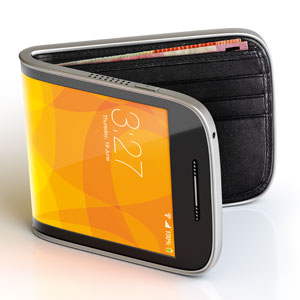
ThMobile phone folded to look like a wallete announcement just before Christmas that Android Pay will arrive in Australia in early 2016 is big news for payments, but it’s also another significant step that’s slowly, but inevitably, taking mobile payments from niche to mainstream. There has been a lot of chatter about mobile wallets being the future of payments in Australia, but so far we haven’t seen many people actually use their mobile phones as wallets.
2016 is looking like the year that will change this – why?

Apple’s here, Android’s coming and Samsung won’t be far behind
Many Australian iphone users have been patiently waiting for the chance to use Apple Pay to make payments and it finally arrived in November last year as part of a deal with Amex. What has made the arrival of Apple Pay less of an event in Australia than in other countries is that it can currently only be used by people who have an iphone 6 or 6+ and an American Express card that’s issued by Amex (the Amex ‘companion’ cards, issued by banks, aren’t able to be used). This means that only a very small amount of iphones in Australia can actually be used with Apple Pay right now.

Google has announced that Android Pay will be here in early 2016 and it’s rumoured that Samsung won’t be far behind. Google, Apple and Samsung (aka “The Pays”) are already involved in the war for mobile handset prominence and the next frontline is the mobile wallet where The Pays will all be competing for prominence. The Pays are slick, work well and their functionality is continually being enhanced as usage increases. While Australian mobile banking apps are some of the best in the world, take-up from similar overseas markets (like the UK) indicates that The Pays are already having significant uptake within a short space of time after launch.

The Pays all have similar functionality, Android and Samsung are usable on many of the same devices, and all are likely to arrive in Australia at roughly the same time. Without many clear differences between the products they will be battling to win their place in the wallets of customers through their marketing and advertising spend.

Banks will be competing to be ‘top of wallet’
Just the same as banks currently compete to be the card of choice in customers’ physical wallets, the same thing will soon be happening in the mobile world. Although you will be able to store multiple cards in some mobile wallets, all of The Pays will have a default card installed in the app. So whichever banks are more successful at having their cards installed as the default card will earn the lion’s share of the income generated by processing the transactions through the wallets. For banks which aren’t the default card it will be much harder for them to overcome customer change inertia and get their card ‘top of wallet’.

This means that banks are likely to use their own considerable marketing budgets and strong customer relationships to try to get their customers to install their card as the default. This will increase the noise around the arrival of The Pays and increase customer uptake.

Fully integrated mobile wallets are starting to become a reality
Part of the reason that Australians continue to pay with their credit and debit cards instead of their phones is that at the moment mobile tap and pay doesn’t offer a compelling proposition over and above card tap and pay. Also, as banks generally earn the same amount if a cardholder uses their card or their mobile to make a payment, they have had no particular incentive to migrate people from cards to mobiles.

Mobile wallets will really take off when they offer something different, and better, than cards. Eventually we will see mobile wallets incorporate all of the cards in our wallets including ID cards, medicare and health insurance cards and travel cards like Opal and Myki (as is already happening in the UK). We’re starting to see the first stage of this in Australia with the incorporation of loyalty cards into mobile wallets (all of the Pays will have this capability, although not necessarily at launch). This means that people won’t have to remember to carry their various loyalty cards and their credit/debit card – everything will be stored in the same place, their mobile wallet.

The battle to be top of wallet has started and we don’t know who will win.
Now that the battle to be top of wallet has commenced, things will heat up quickly. And as many of the competitors have very deep pockets and aren’t used to losing, it’s likely to be long and fierce. The only definite winners will be consumers as banks, mobile companies and merchants improve the user experience and functionality of their offerings.

At Cuscal we are working with our financial institution clients to connect them to Android Pay from Day 1 (and the other Pays when they arrive). We want to ensure all of our clients can compete on a level playing field for their place in the wallets of the future.

Cuscal will connect clients to Android Pay Day 1

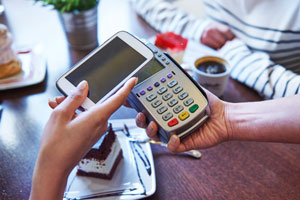
Mobile phone paying at POS terminal
Sydney, 16 December 2015
: Cuscal, one of Australia’s leading providers of end-to-end payments solutions, is pleased to announce that it will be ready to connect its financial institution clients to Android Pay as soon as it launches in Australia.

Cuscal’s clients include over 70 Australian financial institutions to which it supplies a range of products including credit and debit cards and a mobile banking app with HCE contactless payments capability. All of these will be able to connect to Android Pay.

Commenting on the launch of Android Pay Adrian Lovney, Cuscal’s General Manager of Product and Services said:

“It’s a very exciting time for mobile payments in Australia and Cuscal is right in the thick of it. We have been working with Google to make sure that our clients will be able to connect to Android Pay from Day 1, giving them a level playing field to compete with the big banks for their share of customers’ mobile wallets.”

Media contact
Jake Waddell jwaddell@cuscal.com.au 0417 312 902